美国国家应急准备指导方针(2007)
写在前面:今年3月底我开始组织专家志愿者翻译情景构建资料,5月初翻译小组组建完成,第一份资料是《美国国家应急规划情景(2006)》(National Planning Scenarios),刘书骏老师(lshj1943@126.com)加入了翻译单元1:“情景1:核爆炸攻击 - 10千吨简易核装置”的翻译工作。没想到5月23日刘老师就把《美国国家应急准备指导方针(2007)》(National Preparedness Guidelines 2007)的译文发给我,这份资料极为重要,已列入情景构建资料翻译清单但尚未排入计划,没想到刘老师抽空把它翻译了,给了我一个很大的惊喜。但因个人时间安排问题,直到7月初我再把自己的翻译意见反馈给刘老师。
以下中文简译是我的校译稿,感谢刘书骏老师抽出个人休息时间进行翻译工作。如译文中有任何不准确或理解错误的地方,都是由于我的原因造成,与刘老师无关。如对译文有意见或修改建议,请给我留言。
欢迎更多的专家志愿者加入我们的翻译工作,把更多的业务连续性和韧性相关专业资料带给专业共同体。
王曙(kevinwang) 2024.08.23
美国国家应急准备指导方针(2007) National Preparedness Guidelines 2007
前言 PREFACE
布什总统领导了加强国家准备能力的坚定努力。国家准备架构包括全方位的预防、保护、响应和恢复工作,以使国家准备好应对所有危险 — 无论是恐怖袭击还是自然灾害。
President Bush has led a committed effort to strengthen the Nation’s preparedness capabilities. The national preparedness architecture encompasses the full spectrum of prevention, protection, response, and recovery efforts to prepare the Nation for all hazards – whether terrorist attack or natural disaster.
2003年12月17日的国土安全总统令第8号(HSPD-8)(“国家准备”)指示国土安全部长制定国家国内全危险准备目标。作为这项工作的一部分,2005年3月,国土安全部(DHS)发布了临时国家准备目标。国家准备指导方针(指导方针)的公布完成了国家目标及其相关准备工具的制定。
Homeland Security Presidential Directive-8 (HSPD-8) of December 17, 2003 (“National Preparedness”) directed the Secretary of Homeland Security to develop a national domestic all-hazards preparedness goal. As part of that effort, in March 2005 the Department of Homeland Security (DHS) released the Interim National Preparedness Goal. Publication of the National Preparedness Guidelines (Guidelines) finalizes development of the national goal and its related preparedness tools.
指导方针,包括同时在线公布的支持性的目标能力清单,取代了临时国家准备目标,并定义了国家准备好应对所有危险的意义。指导方针有四个关键要素:
The Guidelines, including the supporting Target Capabilities List, simultaneously published online, supersedes the Interim National Preparedness Goal and defines what it means for the Nation to be prepared for all hazards. There are four critical elements of the Guidelines:
(1)国家准备愿景,提供了国家核心准备目标的简明陈述。
(1) The National Preparedness Vision, which provides a concise statement of the core preparedness goal for the Nation.
(2)国家规划情景,描述了潜在恐怖袭击和自然灾害的各种高后果威胁情景。总体来说,这15种情景旨在将国土安全准备工作的应急计划重点放在各级政府和私营部门。这些情景构成了为准备好应对所有类型紧急情况所需的协调一致的联邦规划、培训、演练和拨款投资的基础。
(2) The National Planning Scenarios, which depict a diverse set of high-consequence threat scenarios of both potential terrorist attacks and natural disasters. Collectively, the 15 scenarios are designed to focus contingency planning for homeland security preparedness work at all levels of government and with the private sector. The scenarios form the basis for coordinated Federal planning, training, exercises, and grant investments needed to prepare for emergencies of all types.
(3)通用任务列表(UTL)是一个包含约1600项独特任务的菜单,可以促进预防、保护、响应和恢复国家规划情景所代表的重大事件。它给出了一个公共词汇表,并确定了支持各级组织发展基本能力的关键任务。当然,没有组织会执行每一项任务。
(3) The Universal Task List (UTL), which is a menu of some 1,600 unique tasks that can facilitate efforts to prevent, protect against, respond to, and recover from the major events that are represented by the National Planning Scenarios. It presents a common vocabulary and identifies key tasks that support development of essential capabilities among organizations at all levels. Of course, no entity will perform every task.
(4)目标能力清单(TCL),定义了社区、私营部门和各级政府为有效应对灾难而应总体拥有的37项具体能力。
(4) The Target Capabilities List (TCL), which defines 37 specific capabilities that communities, the private sector, and all levels of government should collectively possess in order to respond effectively to disasters.
指导方针强化了一个事实,准备是一项共同责任。它是通过一个涉及1500多名联邦、州和地方官员以及120多个全国性协会的广泛的过程制定的。它们还整合了卡特里娜飓风后的经验教训,以及2006年对各州和主要城市应急行动和疏散计划的审查。
The Guidelines reinforce the fact that preparedness is a shared responsibility. They were developed through an extensive process that involved more than 1,500 Federal, State, and local officials and more than 120 national associations. They also integrate lessons learned following Hurricane Katrina and a 2006 review of States’ and major cities’ emergency operations and evacuation plans.
保护美国需要时刻保持警醒和创新。这些指导方针将塑造和支持未来数月和数年的准备活动,同时随着国家加强各级政府和私营部门的准备而与国家一起成长和发展。
Protecting America requires constant vigilance and innovation. These Guidelines will shape and support preparedness activities in the months and years ahead, while growing and evolving with the Nation as it strengthens preparedness at all levels of government and within the private sector.
——迈克尔·切尔托夫 国土安全部部长 2007年9月
— Michael Chertoff Secretary of Homeland Security September 2007
目录
前言
1.0引言
2.0愿景
2.1指导方针是一系列就绪举措的综合体
2.2指导方针是适用于全危险的
2.3指导方针是基于风险的
2.4指导方针是行动的号召
3.0能力
4.0优先事项
4.1扩大区域合作
4.2实施国家事件管理体系和国家响应计划
4.3实施国家基础设施保护计划
4.4加强信息共享和协作能力
4.5加强可互操作和可操作的通信能力
4.6加强CBRNE检测、响应和净化能力
4.7加强医疗激增和大规模预防能力
4.8社区准备:加强规划和公民能力
5.0国家准备系统支持指导方针
6.0管理和维护
附录A——指令函
附录B——基于能力的准备概述
附录C——术语和定义
附录D——首字母缩略词和缩写词
图表列表 图1:指导方针语境
图2:能力
图3:能力要素
图4:能力和结果
图5:国家优先事项和相关能力
图6:国家准备系统
图B-1:国家规划情景
图B-2:基于能力的准备过程
TABLE OF CONTENTS
PREFACE
1.0 INTRODUCTION
2.0 VISION
2.1 The Guidelines Are the Umbrella for a Range of Readiness Initiatives
2.2 The Guidelines Are All-Hazards
2.3 The Guidelines Are Risk-Based
2.4 The Guidelines Are a Call to Action
3.0 CAPABILITIES
4.0 PRIORITIES
4.1 Expand Regional Collaboration
4.2 Implement the National Incident Management System and National Response Plan
4.3 Implement the National Infrastructure Protection Plan
4.4 Strengthen Information Sharing and Collaboration Capabilities
4.5 Strengthen Interoperable and Operable Communications Capabilities
4.6 Strengthen CBRNE Detection, Response, and Decontamination Capabilities
4.7 Strengthen Medical Surge and Mass Prophylaxis Capabilities
4.8 Community Preparedness: Strengthening Planning and Citizen Capabilities
5.0 A NATIONAL PREPAREDNESS SYSTEM SUPPORTS THE GUIDELINES
6.0 MANAGEMENT AND MAINTENANCE
APPENDIX A— Letter of Instruction
APPENDIX B— Capabilities-Based Preparedness Overview
APPENDIX C— Terms and Definitions
APPENDIX D— Acronyms and Abbreviations
LIST OF FIGURES Figure 1: The Guidelines in Context
Figure 2: Capabilities
Figure 3: Elements of Capability
Figure 4: Capabilities and Outcomes
Figure 5: National Priorities and Associated Capabilities
Figure 6: National Preparedness System
Figure B-1: National Planning Scenarios
Figure B-2: Capabilities-Based Preparedness Process
原文Vi页及译文从略
1.0 引言 INTRODUCTION
2003年12月17日,总统发布了HSPD-8。HSPD-8确立了加强美国准备工作的国家政策,以预防、保护、响应和恢复美国境内受到威胁或实际发生的恐怖袭击、重大灾难和其他紧急情况。HSPD-8指示国土安全部长与其他相关联邦部门和机构的负责人协调,并与州、地方、部落和领地政府协商,制定国家国内全危险准备目标。国家准备指导方针(指导方针)完成了国家准备目标及其相关准备工具的制定。
On December 17, 2003, the President issued HSPD-8. HSPD-8 established national policies to strengthen the preparedness of the United States to prevent, protect against, respond to, and recover from threatened or actual terrorist attacks, major disasters, and other emergencies within the United States. HSPD-8 directed the Secretary of Homeland Security to develop a national domestic all-hazards preparedness goal in coordination with the heads of other appropriate Federal departments and agencies and in consultation with State, local, tribal, and territorial governments. The National Preparedness Guidelines (Guidelines) finalize development of the national preparedness goal and its related preparedness tools.
指导方针旨在:
- 组织并同步全国(包括联邦、州、地方、部落和领地)加强国家准备的工作;
- 指导国家在国家准备方面的投资;
- 将从过去灾难中吸取的经验教训纳入国家准备优先事项;
- 促进基于能力和基于风险的投资规划过程;和
- 建立衡量进展情况的就绪度指标,并建立一个系统评估国家应对重大事件(特别是涉及恐怖主义行为)的总体准备能力。
The purposes of the Guidelines are to:
- Organize and synchronize national (including Federal, State, local, tribal, and territorial) efforts to strengthen national preparedness;
- Guide national investments in national preparedness;
- Incorporate lessons learned from past disasters into national preparedness priorities;
- Facilitate a capability-based and risk-based investment planning process; and
- Establish readiness metrics to measure progress and a system for assessing the Nation’s overall preparedness capability to respond to major events, especially those involving acts of terrorism.
指导方针包括国家准备的愿景、能力和优先事项。为了支持在全国范围内采取一致的实施方法,指导方针建立了三个基于能力的准备工具和一个国家准备系统 — 所有这些都在以下章节讨论。
The Guidelines include a vision, capabilities, and priorities for national preparedness. In order to support a consistent nationwide approach to implementation, the Guidelines establish three capabilities-based preparedness tools and a National Preparedness System – all of which are discussed in the sections that follow.
2.0 愿景 VISION
国家准备指导方针的愿景是:一个以平衡风险与资源和需求的方式,准备好具有协调一致的能力以预防、保护、响应所有危险并从中恢复的国家。
The vision for the National Preparedness Guidelines is: A NATION PREPARED with coordinated capabilities to prevent, protect against, respond to, and recover from all hazards in a way that balances risk with resources and need.
这一愿景意义深远。它认识到,准备需要各级政府以及私营部门、非政府组织和公民个人的协调一致的国家努力。它涉及从预防到恢复的全方位国土安全使命的基于能力的准备。几十年来,各州、社区和联邦政府一直在合作应对自然灾害和技术紧急情况,特别是在响应和恢复方面。然而,他们在恐怖袭击方面的经验要少得多,特别是在预防和保护方面。指导方针涉及所有危险,并高度重视处于风险连续统中灾难性端点的事件,特别是恐怖袭击,这需要迅速和协调一致的国家行动。这一愿景承认,国家不可能对每一种可能的突发事件都做好充分准备,而且没有两个管辖区拥有相同的能力需求。在确定应对每种突发事件的可用资源和每个社区的独特需求时,我们必须权衡灾难性事件的相对风险,根据风险确定如何最好地满足需求,从而实现最佳和合理的准备水平。
This vision is far-reaching. It recognizes that preparedness requires a coordinated national effort involving every level of government, as well as the private sector, nongovernmental organizations, and individual citizens. It addresses capabilities-based preparedness for the full range of homeland security missions, from prevention through recovery. States, communities, and the Federal Government have worked together for decades to manage natural disasters and technological emergencies, particularly with regard to response and recovery. However, they have far less experience with terrorist attacks, particularly with regard to prevention and protection. The Guidelines address all hazards and place heavy emphasis on events at the catastrophic end of the risk continuum, especially terrorist attacks, which would require rapid and coordinated national action. The vision acknowledges that the Nation cannot achieve total preparedness for every possible contingency and that no two jurisdictions possess identical capability needs. We must weigh the relative risk of catastrophic events when determining the resources available to address each contingency and the unique needs of each community, determine how to best address needs in light of the risks, and thereby achieve optimal and reasonable levels of preparedness.
2.1 指导方针是一系列就绪举措的综合体 The Guidelines Are the Umbrella for a Range of Readiness Initiatives
HSPD-8是旨在解决国家应如何准备预防、保护、响应和从重大事件中恢复的几项总统令之一。其他总统令涉及恐怖主义袭击和自然灾害造成的不断演变的威胁。
HSPD-8 is one of several presidential directives that address how the Nation should prepare to prevent, protect against, respond to, and recover from major incidents. Other presidential directives address the evolving threats posed by terrorist attacks and natural disasters.
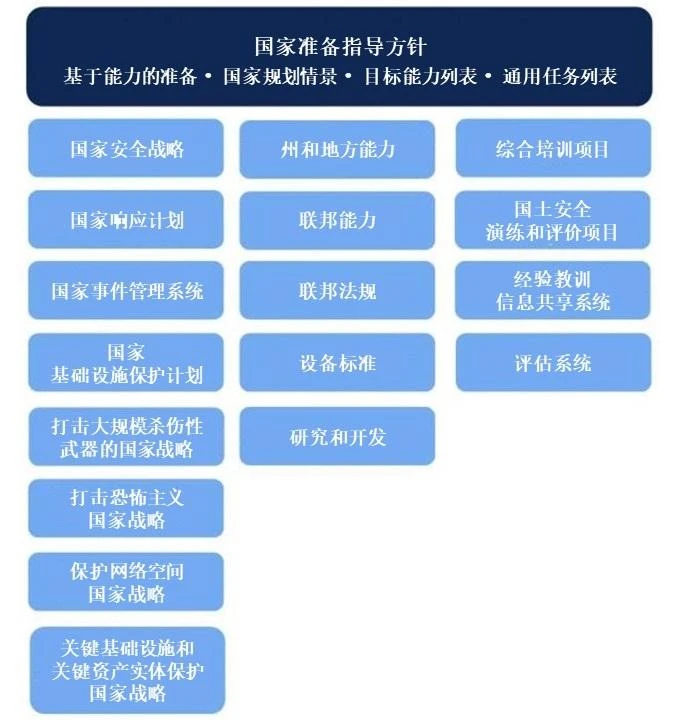
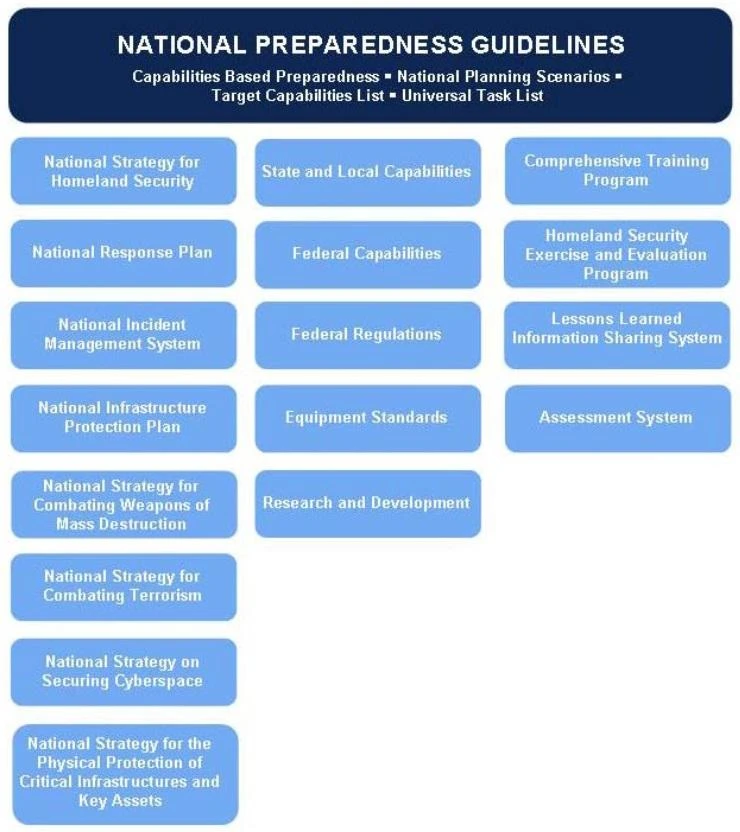
指导方针是总括性文件,将许多计划、战略和系统整理成一个总体框架,即国家准备系统。计划和系统将得到实施,要求将与资源相匹配,符合适用法律并受拨款的限制。
The Guidelines are umbrella documents that collate many plans, strategies, and systems into an overarching framework, the National Preparedness System. Plans and systems will be implemented and requirements will be matched with resources, consistent with applicable law and subject to the availability of appropriations.
2.2 指导方针是适用于全危险的 The Guidelines Are All-Hazards
根据总统在HSPD-8中的指示,指导方针采用了一种全危险的准备方法。全危险方法涉及基于能力的准备,以预防、保护、响应恐怖袭击、重大灾难和其他紧急情况并从中恢复。
As directed by the President in HSPD-8, the Guidelines adopt an all-hazards approach to preparedness. An all-hazards approach addresses capabilities-based preparedness to prevent, protect against, respond to, and recover from terrorist attacks, major disasters, and other emergencies.
2.3 指导方针是基于风险的 The Guidelines Are Risk-Based
指导方针确立了基于风险的准备方法。风险是三个变量的函数:威胁、脆弱性和后果。威胁和脆弱性都受到高度不确定事件概率的影响。为了克服这种不确定性,指导方针提供了一套国家规划情景,代表需要国家关注的一系列威胁。国家规划情景建立了共同的假设,以指导关于重大事件潜在脆弱性和后果(或影响)的全国范围的规划。分析潜在影响的范围对于从容量(即需要多少)和熟练程度(即他们必须能够表现得多好)两个方面定义能力至关重要。这些能力必须反映在应急行动计划(近期)和准备战略(长期)中。联邦、州、地方、部落和领地官员通过风险评估对这种方法进行补充,这些评估提供有关其具体威胁、脆弱性和后果的额外数据。因此,官员们可以根据全国各地的风险差异来调整他们的方法。
The Guidelines establish a risk-based approach to preparedness. Risk is a function of three variables: threat, vulnerability, and consequence. Both threat and vulnerability are influenced by the probabilities of events that are highly uncertain. In order to compensate for that uncertainty, the Guidelines provide a set of National Planning Scenarios that represent a range of threats that warrant national attention. The National Planning Scenarios establish common assumptions to guide planning nationwide regarding potential vulnerabilities and consequences (or impacts) of major incidents. Analysis of the range of potential impacts is essential for defining capabilities in terms of both capacity (i.e., how many are needed) and proficiency (i.e., how well must they be able to perform). These capabilities must be reflected in emergency operations plans (for the near-term) and in preparedness strategies (for the long-term). Federal, State, local, tribal, and territorial officials supplement this approach with risk assessments that provide additional data on their specific threats, vulnerabilities, and consequences. As a result, officials can tailor their approach according to differences in risk across the Nation.
2.4 指导方针是行动的号召 The Guidelines Are a Call to Action
准备是成功实施国家事件管理系统(NIMS)的基础。NIMS使各个联邦、州、地方、部落和领地政府和机构担负起责任,在事件发生前建立准备周期,并酌情将私营部门、非政府组织和公民个人纳入。预防、保护、响应和恢复使命的准备周期可总结如下:
- 计划
- 组织并配备人员
- 装备
- 培训
- 演练、评价和改进
Preparedness is the foundation of successful National Incident Management System (NIMS) implementation. The NIMS places responsibility on individual Federal, State, local, tribal, and territorial governments and agencies for establishing a preparedness cycle in advance of an incident and for including the private sector, non-governmental organizations, and individual citizens, as appropriate. The cycle of preparedness for prevention, protection, response, and recovery missions may be summarized as follows:
- Plan
- Organize and Staff
- Equip
- Train
- Exercise, Evaluate, and Improve
准备是各级政府、每个部门和每个机构的责任,与其权力保持一致。这包括协调在其管辖区边界内动作的合作伙伴之间的准备活动,以及在确定的威胁和风险评估要求时跨管辖和地理边界开展的准备活动。应在NIMS中所述的相同多机构协调实体之间协调准备。这是实施指导方针的基础,特别是扩大地区合作的国家优先事项(见第4.1节)。
Preparedness is the responsibility of every level of government, every department, and every agency consistent with its authorities. This includes coordinating preparedness activities among partners operating within their jurisdictional borders, as well as across jurisdictional and geographic borders when dictated by identified threats and risk assessments. Preparedness should be coordinated across the same multi-agency coordination entities as described in the NIMS. This is the basis for implementing the Guidelines, particularly the national priority to Expand Regional Collaboration (see Section 4.1).
联邦、州、地方、部落和领地政府与私营和非营利部门合作,都在支持由指导方针建立的准备框架方面发挥着独特的作用。各级政府应将社区、宗教和其他非政府组织的能力整合进其准备和响应计划。这种整合包括让这些组织参与规划过程,为其人员提供必要的培训和资格认证,为参与联合响应提供必要的资源支持,并将这些组织纳入培训和演练。最重要的是建立协调通过这些组织提供的志愿者、货物和服务的机制。
Federal, State, local, tribal, and territorial governments, in cooperation with the private and non-profit sectors, each have a unique role in supporting the preparedness framework established by the Guidelines. All levels of government should integrate into their preparedness and response plans the capacity of community, faith-based, and other nongovernmental organizations. This integration includes engaging such organizations in the planning process, providing necessary training and credentialing of their personnel, providing necessary resource support for involvement in a joint response, and incorporating the organizations in training and exercises. Of highest importance is the development of mechanisms for coordination of the volunteers, goods, and services available through these organizations.
指导方针为基于能力的准备系统提供了一个国家框架,目的是可测量,以便能够确定进展并做出具体改进。正在制定具体的指标和标准,供司法管辖区在进行准备评估时使用。此外,正在建立一个过程来测量国家的总体准备情况。(关于将指导方针制度化的指导,见附录A中的部长指令函)。
The Guidelines provide a national framework for a capabilities-based preparedness system and are designed to be measurable so that progress can be determined and specific improvements can be made. Specific metrics and standards are under development for jurisdictions to use when conducting preparedness assessments. Additionally, a process is being established to measure the Nation’s overall preparedness. (Guidance on institutionalizing the Guidelines is provided within the Secretary’s Letter of Instruction in Appendix A.)
3.0 能力 CAPABILITIES
指导方针确立了一种基于能力的准备方法。简单地说,能力提供了完成使命的方法。指导方针涉及所有国土安全使命领域的准备:预防、保护、响应和恢复。以下按使命领域的字母顺序列出了能力,以便于查阅(见图2)。有些能力跨所有使命领域,因此被置于公共使命领域。
The Guidelines establish a capabilities-based approach to preparedness. Simply put, a capability provides the means to accomplish a mission. The Guidelines address preparedness for all homeland security mission areas: prevention, protection, response, and recovery. Capabilities are presented alphabetically below by mission area for ease of reference (see Figure 2). Some capabilities cut across all mission areas and are therefore placed in a Common Mission Area.
图2:能力(Figure 2: Capabilities)
| 公共使命领域 Common Mission Area | 响应使命领域 Response Mission Area |
|---|---|
| 通信 Communications 社区准备和参与 Community Preparedness and Participation 规划 Planning 风险管理 Risk Management 情报/信息共享和传播 Intelligence/Information Sharing and Dissemination | 动物健康紧急支持 Animal Health Emergency Support 公民疏散和就地避难 Citizen Evacuation and Shelter-in-Place 关键资源的物流和分发 Critical Resource Logistics and Distribution 紧急行动中心管理 Emergency Operation Center Management 紧急公共信息和警报 Emergency Public Information and Warning 环境卫生 Environmental Health 爆炸装置响应行动 Explosive Device Response Operations 死亡管理 Fatality Management 火灾事件响应支持 Fire Incident Response Support 隔离和检疫 Isolation and Quarantine 大规模护理(庇护、供养和相关服务)Mass Care (Sheltering, Feeding, and Related Services) 大规模预防 Mass Prophylaxis 医疗用品管理和配送 Medical Supplies Management and Distribution 医疗激增 Medical Surge 现场事件管理 Onsite Incident Management 紧急公共安全和安保响应 Emergency Public Safety and Security Response 响应者安全与健康 Responder Safety and Health 急诊分诊和院前治疗 Emergency Triage and Pre-Hospital Treatment 搜索和救援(陆基)Search and Rescue (Land-Based) 志愿者管理与捐赠 Volunteer Management and Donations 大规模杀伤性武器/危险材料响应和净化 WMD/Hazardous Materials Response and Decontamination |
| 预防使命领域 Prevent Mission Area | |
| CBRNE检测 CBRNE Detection 信息收集、指标识别和预警 Information Gathering and Recognition of Indicators and Warning 情报分析和生产 Intelligence Analysis and Production 反恐调查和执法 Counter-Terror Investigation and Law Enforcement | |
| 保护使命领域 Protect Mission Area | 恢复使命领域 Recovery Mission Area |
| 关键基础设施保护 Critical Infrastructure Protection 流行病学监测和调查 Epidemiological Surveillance and Investigation 食品和农业安全与防御 Food and Agriculture Safety and Defense 实验室测试 Laboratory Testing | 经济和社区恢复 Economic and Community Recovery 生命线恢复 Restoration of Lifeline 结构损伤评估 Structural Damage Assessment |
资料来源:目标能力清单(2007年9月) Source: Target Capabilities List, as of September 2007
能力由交付预期结果所需的要素组合构成。能力要素与NIMS一致(见图3)。
A capability consists of the combination of elements required to deliver the desired outcome. Capability elements are consistent with the NIMS (see Figure 3).
图3:能力要素(Figure 3: Elements of Capability)
| 要素 Element | 描述 Description |
|---|---|
| 规划 Planning | 收集和分析情报和信息,制定符合相关法律、法规以及执行指定使命和任务所需指导意见的政策、计划、程序、互助协议、战略和其他出版物。Collection and analysis of intelligence and information, and development of policies, plans, procedures, mutual aid agreements, strategies, and other publications that comply with relevant laws, regulations, and guidance necessary to perform assigned missions and tasks. |
| 组织和领导 Organization and Leadership | 符合相关法律、法规以及执行指定使命和任务所需指导意见的各个团队、整体组织结构以及结构中的各级领导。Individual teams, an overall organizational structure, and leadership at each level in the structure that comply with relevant laws, regulations, and guidance necessary to perform assigned missions and tasks. |
| 人员 Personnel | 符合执行指定使命和任务所需的有关资格和认证标准的受薪和志愿工作人员。Paid and volunteer staff who meet relevant qualification and certification standards necessary to perform assigned missions and tasks. |
| 设备和系统 Equipment and Systems | 符合执行指定使命和任务所需的有关标准的主要设备、物资、设施和系统。Major items of equipment, supplies, facilities, and systems that comply with relevant standards necessary to perform assigned missions and tasks. |
| 培训 Training | 符合执行指定使命和任务所需的有关培训标准的内容和交付方法。Content and methods of delivery that comply with relevant training standards necessary to perform assigned missions and tasks. |
| 演练、评价和纠正措施 Exercises, Evaluations, and Corrective Actions | 按照实现成功结果所需标准执行指定使命和任务,提供机会来展示、评价和改进其他要素的结合能力和互操作性的演练、自评估、同行评估、外部审查、合规监测和实际重大事件。Exercises, self-assessments, peer-assessments, outside reviews, compliance monitoring, and actual major events that provide opportunities to demonstrate, evaluate, and improve the combined capability and interoperability of the other elements to perform assigned missions and tasks to standards necessary to achieve successful outcomes. |
交付预期结果的任何元素组合都是可接受的(见图4)。
Any combination of elements that delivers the desired outcome is acceptable (see Figure 4).
图4:能力和结果 Capabilities and Outcomes
| 能力 Capability | 结果 Outcome |
|---|---|
| 公共 Common | |
| 通信 Communications | 结果:在符合NIMS的应急响应行动期间,多管辖区和多学科的应急响应者、指挥所、机构和政府官员之间能够保持关键信息的持续流动。 Outcome: A continuous flow of critical information is maintained as needed among multi-jurisdictional and multi-disciplinary emergency responders, command posts, agencies, and governmental officials for the duration of the emergency response operation in compliance with the NIMS. |
| 社区准备和参与 Community Preparedness and Participation | 结果:在各级政府和非政府组织之间建立了持续合作的结构和过程;志愿者和非政府资源被纳入计划和演练中;公众受过教育、培训并保持警惕。 Outcome: There is a structure and a process for ongoing collaboration between government and nongovernmental organizations at all levels; volunteers and nongovernmental resources are incorporated in plans and exercises; the public is educated, trained, and aware. |
| 规划 Planning | 结果:计划包括准确的威胁分析和风险评估,确保在需要的时间和地点提供预防、保护、响应和恢复全危险事件所需的能力。 Outcome: Plans incorporate an accurate threat analysis and risk assessment and ensure that capabilities required to prevent, protect against, respond to, and recover from all-hazards events are available when and where they are needed. |
| 风险管理 Risk Management | 结果:联邦、州、地方、部落、领地和私营部门组织识别和评估风险,根据风险的降低确定优先级并选择适当的保护、预防和缓解方案。 Outcome: Federal, State, local, tribal, territorial, and private-sector entities identify and assess risks, prioritize and select appropriate protection, prevention, and mitigation solutions based on reduction of risk. |
| 情报/信息共享和传播 Intelligence/Information Sharing and Dissemination | 结果:联邦、州、地方、部落、领地、区域和私营部门实体之间有效、及时地共享信息和情报。 Outcome: Effective and timely sharing of information and intelligence occurs across Federal, State, local, tribal, territorial, regional, and private sector entities. |
| 预防使命领域 Prevent Mission Area | |
| CBRNE检测 CBRNE Detection | 结果:在边境和入境口岸、关键地点、事件和事故中迅速检测和描述化学、生物、辐射性、核和/或爆炸物(CBRNE)材料。 Outcome: Chemical, biological, radiological, nuclear, and/or explosive (CBRNE) materials are rapidly detected and characterized at borders and ports of entry, critical locations, events, and incidents. |
| 信息收集,指标识别和预警 Information Gathering and Recognition of Indicators and Warnings | 结果:识别、收集当地产生的威胁和其他犯罪和/或恐怖主义相关的信息,将其输入适当的数据/检索系统,并提供给适当的分析中心。 Outcome: Locally generated threat and other criminal and/or terrorism-related information is identified, gathered, entered into an appropriate data/retrieval system, and provided to appropriate analysis centers. |
| 情报分析和生产 Intelligence Analysis and Production | 结果:制作及时、准确和可行动的情报/信息产品,以支持预防、感知、威慑、响应和连续性规划行动。 Outcome: Timely, accurate, and actionable intelligence/information products are produced in support of prevention, awareness, deterrence, response, and continuity planning operations. |
| 反恐调查和执法 Counter-Terror Investigations and Law Enforcement | 结果:成功威慑、侦查、瓦解、调查和逮捕参与了国土安全相关犯罪活动的嫌疑人。 Outcome: Suspects involved in criminal activities related to homeland security are successfully deterred, detected, disrupted, investigated, and apprehended. |
| 保护使命领域 Protect Mission Area | |
| 关键基础设施保护 Critical Infrastructure Protection | 结果:通过识别关键基础设施,降低关键基础设施受到攻击的风险、脆弱性和后果。 Outcome: The risk to, vulnerability of, and consequence of an attack on critical infrastructure are reduced through the identification of critical infrastructure. |
| 流行病学监测和调查 Epidemiological Surveillance and Investigation | 结果:通过确定接触、传播方式和病原体,迅速确定潜在的疾病接触;阻断传输以遏制事件的蔓延;减少病例数量。 Outcome: Potential exposure to disease is identified rapidly by determining exposure and mode of transmission and agent; interrupting transmission to contain the spread of the event; and reducing number of cases. |
| 食品和农业安全与防御 Food and Agriculture Safety and Defense | 结果:预防、缓解和消除对粮食和农业安全的威胁;处理受影响的产品;对受影响的设施进行净化。 Outcome: Threats to food and agricultural safety are prevented, mitigated, and eradicated; affected products are disposed of; affected facilities are decontaminated. |
| 公共卫生实验室测试 Public Health Laboratory Testing | 结果:由管理区内的公共卫生实验室或通过与其它适当的联邦、州和地方实验室的网络合作,迅速发现并准确识别引起或可能引起广泛疾病或死亡的化学、辐射性和生物制剂。 Outcome: Chemical, radiological, and biological agents causing, or having the potential to cause, widespread illness or death are rapidly detected and accurately identified by the public health laboratory within the jurisdiction or through network collaboration. |
| 响应使命领域 Respond Mission Area | |
| 动物疾病应急支持 Animal Disease Emergency Support | 结果:通过保护相关的关键基础设施和关键资产,阻止外国动物疾病进入美国。 Outcome: Foreign animal disease is prevented from entering the United States by protecting the related critical infrastructure and key assets. |
| 公民疏散和就地避难 Citizen Evacuation and Shelter-In-Place | 结果:受影响和有风险的人群被安全地安置在原地或疏散到安全的避难区。 Outcome: Affected and at-risk populations are safely sheltered-in-place or evacuated to safe refuge areas. |
| 关键资源物流和分发 Critical Resource Logistics and Distribution | 结果:应请求,事件管理人员和应急响应人员可获得关键资源。 Outcome: Critical resources are available to incident managers and emergency responders upon request. |
| 应急行动中心管理 Emergency Operations Center Management | 结果:通过多机构协调对预先计划或无通知的事件进行有效管理。 Outcome: The event is effectively managed through multi-agency coordination for a pre-planned or no-notice event. |
| 紧急公共信息和警告 Emergency Public Information and Warning | 结果:政府机构、公共和私营部门实体通过清晰、一致的信息传递系统接收和传递有关其健康、安全和财产受到威胁的协调一致、及时、有用和可靠的信息。 Outcome: Government agencies and public and private sector entities receive and transmit coordinated, prompt, useful, and reliable information regarding threats to their health, safety, and property. |
| 环境卫生 Environmental Health | 结果:在原发性事件发生后,通过快速识别相关的环境危害,预防疾病和伤害。 Outcome: After the primary event, disease and injury are prevented through the quick identification of associated environmental hazards. |
| 爆炸装置响应行动 Explosive Device Response Operations | 结果:进行威胁评估,使爆炸物和/或危险装置安全,并清除该区域的危险。 Outcome: Threat assessments are conducted, the explosive and/or hazardous devices are rendered safe, and the area is cleared of hazards. |
| 死亡管理 Fatality Management | 结果:完整记录并回收人体遗骸和证据。 Outcome: Complete documentation and recovery of human remains and items of evidence. |
| 火灾事件响应支持 Fire Incident Response Support | 结果:初始灭火资源的调度和安全到达在管辖区响应时间目标内发生。 Outcome: Dispatch and safe arrival of the initial fire suppression resources occur within jurisdictional response time objectives. |
| 隔离和检疫 Isolation and Quarantine | 结果:对患病、接触或可能接触的个人进行隔离,限制其行动。 Outcome: Individuals who are ill, exposed, or likely to be exposed are separated, movement is restricted. |
| 大规模护理(庇护、喂养和相关服务)Mass Care (Sheltering, Feeding, and Related Services) | 结果:迅速为受影响地区的人群和伴侣动物提供包括庇护、喂养和批量分发在内的大规模护理服务。 Outcome: Mass care services, including sheltering, feeding, and bulk distribution, are rapidly provided for the population and companion animals within the affected area. |
| 大规模预防 Mass Prophylaxis | 结果:在事件发生时及时实施适当的药物预防和疫苗接种策略。 Outcome: Appropriate drug prophylaxis and vaccination strategies are implemented in a timely manner upon the onset of an event. |
| 医疗用品管理与配送 Medical Supplies Management and Distribution | 结果:关键医疗用品和设备得到妥善保护、管理、配送。 Outcome: Critical medical supplies and equipment are appropriately secured, managed, distributed. |
| 医疗激增 Medical Surge | 结果:因事件而受伤或生病的人员得到迅速和适当地护理。 Outcome: Injured or ill from the event are rapidly and appropriately cared for. |
| 现场事件管理 Onsite Incident Management | 结果:通过ICS的公共框架安全、有效和高效地管理事件。 Outcome: The event is managed safely, effectively, and efficiently through the common framework of the ICS. |
| 紧急公共安全和安保响应 Emergency Public Safety and Security Response | 结果:事故现场得到评估和保护;进出受到控制。 Outcome: The incident site is assessed and secured; access is controlled. |
| 响应者安全与健康 Responder Safety and Health | 结果:在事件期间保护第一响应者并减轻任何进一步的公共风险。 Outcome: First responders are protected during an incident and any further public risk is mitigated. |
| 急诊分诊和院前治疗 Emergency Triage and Pre-Hospital Treatment | 结果:为受害者提供现场医疗评估、治疗和运输。 Outcome: On-site medical assessment, treatment, and transport for victims is provided. |
| 搜索和救援(陆基)Search and Rescue (Land-Based) | 结果:在保证救援人员安全的同时,在最短时间内救出最多的受害者。 Outcome: The greatest numbers of victims are rescued in the shortest period of time while ensuring rescuer safety. |
| 志愿者管理与捐赠 Volunteer Management and Donations | 结果:以协调一致的方式有效管理和部署志愿者、捐赠和自发提供者。 Outcome: Volunteers, donations, and spontaneous offers are effectively managed and deployed in a coordinated manner. |
| 大规模杀伤性武器/危险材料响应和净化 WMD/Hazardous Materials Response and Decontamination | 结果:对大规模杀伤性武器/危险材料事件进行协调一致的响应。 Outcome: A coordinated response to WMD/Hazardous Materials incidents occurs. |
| 恢复使命领域 Recovery Mission Area | |
| 经济和社区恢复 Economic and Community Recovery | 结果:实施恢复计划和行动,以恢复受影响地区的基本服务、企业和商业。 Outcome: Recovery plans and operations are implemented to restore essential services, businesses, and commerce of the affected area. |
| 生命线恢复 Restoration of Lifeline | 结果:关键基础设施的基本功能在事件发生后尽快恢复。 Outcome: Essential functions of critical infrastructure are restored as quickly as possible following the event. |
| 结构损伤评估 Structural Damage Assessment | 结果:出现准确的情况需求和损失评估。全面的工程、建筑检查和执法服务以最大限度地利用资源、协助应急响应和实施恢复行动的方式实施、管理和协调。 Outcome: Accurate situation needs and damage assessments occur. The full range of engineering, building inspection and code enforcement services are implemented, managed, and coordinated in a way that maximizes resource utilization, aids emergency response, and implements recovery. |
资料来源:目标能力清单(2007年9月) Source: Target Capabilities List, as of September 2007
4.0 优先事项 PRIORITIES
HSPD-8指示,指导方针应建立可衡量的准备就绪指标,涵盖预防、保护、响应和恢复使命领域,并建立评估国家总体准备进展的机制。各管辖区应使用这些指标来评估其实现国家优先事项的进展,国家优先事项如下所示。然而,在建立这些机制和指标的最后确定之前,国家优先事项为国家在国家准备方面集中注意力和持续努力提供了基础。
HSPD-8 directs that the Guidelines establish measurable readiness metrics that address the prevention, protection, response, and recovery mission areas, and establish mechanisms to assess the Nation’s overall progress in preparedness. Jurisdictions should use the metrics to assess their progress in achieving the national priorities, which are set forth below. Until the finalization of these mechanisms and metrics, however, the national priorities provide the basis for focused attention and sustained effort for national preparedness.
以下国家优先事项指导联邦、州、地方和部落政府共同努力加强国家准备。实施HSPD-8和管理与预算办公室(OMB)的相关指示,已要求各机构协调并制定战略计划,以整合以下活动范围(见图5)。
The following national priorities guide Federal, State, local, and tribal governments in their collective efforts to strengthen national preparedness. Implementation of HSPD-8 and related direction from the Office of Management and Budget (OMB) already requires agencies to coordinate and develop strategic plans that integrate the following range of activities (see Figure 5).
图5:国家优先事项和相关能力(Figure 5: National Priorities and Associated Capabilities)
| 国家优先事项 National Priority | 相关能力 Associated Capabilities |
|---|---|
| 扩大区域合作 Expand Regional Collaboration | 规划 Planning 风险管理 Risk Management 情报/信息共享和传播 Intelligence/Information Sharing and Dissemination 通信 Communications 紧急公共信息和警告 Emergency Public Information and Warning 紧急行动中心管理 Emergency Operations Center Management 现场事件管理 Onsite Incident Management 应急公共安全和安保响应 Emergency Public Safety and Security Response 响应者安全与健康 Responder Safety and Health |
| 实施国家事件管理系统和国家响应计划 Implement the National Incident Management System and National Response Plan | 规划 Planning 紧急行动中心管理 Emergency Operations Center Management 现场事件管理 Onsite Incident Management 应急公共安全和安保响应 Emergency Public Safety and Security Response 响应者安全与健康 Responder Safety and Health 通信 Communications 关键资源物流和分发 Critical Resource Logistics and Distribution |
| 实施国家基础设施保护计划 Implement the National Infrastructure Protection Plan | 关键基础设施保护 Critical Infrastructure Protection 风险管理 Risk Management 规划 Planning 情报/信息共享和传播 Intelligence/Information Sharing and Dissemination |
| 加强信息共享和协作能力 Strengthen Information Sharing and Collaboration Capabilities | 情报/信息共享和传播 Intelligence/Information Sharing and Dissemination 信息收集、指标识别和预警 Information Gathering and Recognition of Indicators and Warning 情报分析和生产 Intelligence Analysis and Production 反恐调查和执法 Counter-Terror Investigation and Law Enforcement |
| 加强可互操作和可操作的通信能力 Strengthen Interoperable and Operable Communications Capabilities | 通信 Communications 紧急公共信息和警告 Emergency Public Information and Warning 紧急行动中心管理 Emergency Operations Center Management 现场事件管理 Onsite Incident Management |
| 加强CBRNE检测、响应和净化能力 Strengthen CBRNE Detection, Response, and Decontamination Capabilities | CBRNE检测 CBRNE Detection 爆炸装置响应行动 Explosive Device Response Operations 大规模杀伤性武器/危险材料响应和净化 WMD/Hazardous Materials Response and Decontamination 实验室测试 Laboratory Testing 环境卫生 Environmental Health 流行病学监测和调查 Epidemiological Surveillance and Investigation |
| 加强医疗激增和大规模预防能力 Strengthen Medical Surge and Mass Prophylaxis Capabilities | 医疗激增 Medical Surge 大规模预防 Mass Prophylaxis 医疗用品管理和配送 Medical Supplies Management and Distribution 大规模护理(庇护、喂养和相关服务)Mass Care (Sheltering, Feeding, and Related Services) 隔离和检疫 Isolation and Quarantine 死亡管理 Fatality Management 急诊分诊和院前治疗 Emergency Triage and Pre-Hospital Treatment 志愿者管理与捐赠 Volunteer Management and Donations |
| 加强规划和公民准备能力 Strengthen Planning and Citizen Preparedness Capabilities | 规划 Planning 公民疏散和就地避难 Citizen Evacuation and Shelter-in-Place 大规模护理(庇护、喂养和相关服务)Mass Care (Sheltering, Feeding, and Related Services) 社区准备和参与 Community Preparedness and Participation 紧急公共信息和警告 Emergency Public Information and Warning 通信 Communications |
4.1 扩大区域合作 Expand Regional Collaboration
国家优先事项: 通过加强区域合作扩大准备能力。
National Priority: Expand preparedness capabilities through strengthened regional collaboration.
各州和主要城市地区已经建立了机制,通过应急管理援助契约(EMAC)以及在主要城市地区已建立或正在形成的区域合作结构来扩大准备能力。这些安排使各管辖区在应对重大事件时可以汇集资源、共享信息和协调行动。然而,区域合作的程度参差不齐,在许多领域仍处于萌芽状态。扩大区域合作是加强所有其它优先事项的基础。区域合作应包括各级政府和相关利益攸关方,包括私营部门和非政府组织。区域合作应体现NIMS的原则,并反映在区域和地方的互助协议中,这些协议规定了启动协议的条件和程序。
States and major urban areas have already established mechanisms to expand preparedness capabilities through regional collaboration via the Emergency Management Assistance Compact (EMAC), as well as regional collaboration structures already established or being formed across major urban areas. These arrangements enable jurisdictions to pool resources, share information, and coordinate activities when responding to major incidents. However, the degree of regional collaboration varies, and in many areas is still in its infancy. Expanding regional collaboration is fundamental to the strengthening of all other priorities. Regional collaboration should include all levels of government and relevant stakeholders, including the private sector and nongovernmental organizations. Regional collaboration should reflect the principles of NIMS and be reflected in regional and local mutual aid agreements that specify the terms and procedures for activating the agreements.
资源 Resource Links:
- 国家事件管理系统(NIMS)
- 国家响应计划(NRP)
- 应急管理援助契约(EMAC)
- 州和主要城市地区互助协议
4.2 实施国家事件管理系统和国家响应计划 Implement the National Incident Management System and National Response Plan
国家优先事项: 全面实施国家事件管理系统(NIMS)和国家响应计划(NRP)。
National Priority: Fully implement the National Incident Management System (NIMS) and the National Response Plan (NRP).
NIMS提供了一个全国一致的方法,使联邦、州、地方、部落和领地政府、私营部门和非政府组织能够协同应对所有类型的事件,无论其原因、规模或复杂性如何。NIMS包括一个综合性的事件管理系统,涵盖准备、资源管理、通信和信息管理、支持技术以及事件指挥系统的持续管理。NRP将联邦协调结构和能力整合进一个统一的、全危险的、跨部门的方法中,用于国内事件管理。NRP基于NIMS,并使用NIMS提供的事件指挥系统、多机构协调和公共信息框架。NIMS和NRP的成功实施需要各级政府的所有相关部门在事件发生前就熟悉这些系统,并通过培训和演练加以强化。各管辖区必须加强其事件管理能力,以支持NIMS和NRP的实施。
NIMS provides a consistent nationwide approach for Federal, State, local, tribal, and territorial governments, the private sector, and nongovernmental organizations to work together to respond to all types of incidents, regardless of cause, size, or complexity. NIMS includes a comprehensive system for incident management, addressing preparedness, resource management, communications and information management, supporting technology, and the ongoing management of the Incident Command System. The NRP integrates Federal coordination structures and capabilities into a unified, all-hazards, cross-disciplinary approach to domestic incident management. The NRP is built on the NIMS and uses the Incident Command System, multiagency coordination, and public information frameworks provided by the NIMS. Successful implementation of NIMS and the NRP requires that all relevant departments at all levels of government be familiar with these systems prior to an event and that this familiarity is reinforced through training and exercises. Jurisdictions must strengthen their incident management capabilities in order to support NIMS and NRP implementation.
资源 Resource Links:
- 国家事件管理系统(NIMS)
- 国家响应计划(NRP)
- NIMS相关培训课程
4.3 实施国家基础设施保护计划 Implement the National Infrastructure Protection Plan
国家优先事项: 通过实施国家基础设施保护计划(NIPP)加强关键基础设施保护和恢复能力。
National Priority: Strengthen critical infrastructure protection and resiliency capabilities through implementation of the National Infrastructure Protection Plan (NIPP).
国家的关键基础设施和关键资源(CI/KR)对国家的安全、经济发展和公共健康和安全至关重要。NIPP提供了一个全面的风险管理框架,明确定义了CI/KR保护的责任,并整合了联邦、州、地方、部落和领地政府、私营部门以及非政府组织的努力。各管辖区应制定并实施计划,通过采取基于风险的方法识别和优先考虑CI/KR资产以及制定保护计划来保护其社区内的关键基础设施。各管辖区还应制定计划,以确保关键基础设施在事件发生后能够快速恢复功能。
The Nation’s critical infrastructure and key resources (CI/KR) are essential to the Nation’s security, economic development, and public health and safety. The NIPP provides a comprehensive risk management framework that clearly defines CI/KR protection responsibilities and integrates the efforts of Federal, State, local, tribal, and territorial governments, the private sector, and nongovernmental organizations. Jurisdictions should develop and implement plans to protect their critical infrastructure by taking a risk-based approach to identifying and prioritizing CI/KR assets and developing protective programs. Jurisdictions should also develop plans to ensure that critical infrastructure can rapidly restore functionality following an event.
资源 Resource Links:
- 国家基础设施保护计划(NIPP)
- 部门-specific保护计划
- 基础设施风险分析方法
4.4 加强信息共享和协作能力 Strengthen Information Sharing and Collaboration Capabilities
国家优先事项: 通过加强信息共享和协作能力提高预防、保护、响应和恢复能力。
National Priority: Increase prevention, protection, response, and recovery capabilities through strengthened information sharing and collaboration capabilities.
及时、准确和可行动的情报和信息共享对于有效的国土安全工作至关重要。联邦政府已建立了各种机制,如国土安全信息网络(HSIN)、联合反恐特别工作组(JTTF)和州及地方情报融合中心,以促进与州、地方、部落和领地伙伴的信息共享。各管辖区应建立或加强其收集、分析、共享和使用威胁信息的能力,以支持所有使命领域。这包括加强分析能力,发展信息共享协议和程序,并确保敏感信息得到适当保护。
Timely, accurate, and actionable intelligence and information sharing are critical to effective homeland security efforts. The Federal Government has established various mechanisms, such as the Homeland Security Information Network (HSIN), Joint Terrorism Task Forces (JTTFs), and State and local intelligence fusion centers, to facilitate information sharing with State, local, tribal, and territorial partners. Jurisdictions should build or enhance capabilities to gather, analyze, share, and use threat information in support of all mission areas. This includes enhancing analytical capabilities, developing information sharing agreements and procedures, and ensuring that sensitive information is properly protected.
资源 Resource Links:
- 信息共享环境(ISE)
- 融合中心指南
- 国土安全信息网络(HSIN)
4.5 加强可互操作和可操作的通信能力 Strengthen Interoperable and Operable Communications Capabilities
国家优先事项: 加强可互操作和可操作的通信能力以确保有效的响应和恢复行动。
National Priority: Strengthen interoperable and operable communications capabilities to ensure effective response and recovery operations.
有效的事件响应取决于跨越所有管辖区和学科的关键和及时信息的持续流动。卡特里娜飓风和9/11事件的经验教训突显了在重大事件期间无法进行通信的灾难性后果。各管辖区应确保其通信系统满足响应者的操作需求,并能够与其它管辖区和学科的响应者实现互操作。这包括开发标准操作程序,获取和维护可互操作的通信设备,并定期进行联合通信演练以测试互操作性。
Effective incident response depends on a continuous flow of critical and timely information across all jurisdictions and disciplines. The lessons learned from Hurricane Katrina and the 9/11 attacks highlighted the catastrophic consequences of being unable to communicate during major incidents. Jurisdictions should ensure that their communications systems meet the operational needs of responders and are interoperable with those of other jurisdictions and disciplines. This includes developing standard operating procedures, acquiring and maintaining interoperable communications equipment, and conducting regular joint communications exercises to test interoperability.
资源 Resource Links:
- 国家事件管理系统(NIMS)- 通信和信息管理
- 可互操作通信技术中心
- SAFECOM计划
4.6 加强CBRNE检测、响应和净化能力 Strengthen CBRNE Detection, Response, and Decontamination Capabilities
国家优先事项: 加强检测、响应和净化化学、生物、辐射、核和爆炸物(CBRNE)材料的能力。
National Priority: Strengthen capabilities to detect, respond to, and decontaminate chemical, biological, radiological, nuclear, and explosive (CBRNE) materials.
CBRNE事件,包括简易爆炸装置(IED)的使用,对国家构成最严重的威胁。快速检测和准确识别CBRNE材料对于最大程度地减少人员伤亡和启动适当的响应行动至关重要。各管辖区应加强其CBRNE检测能力,包括建立检测网络、配备适当的检测设备和培训人员。他们还应为CBRNE事件中的响应和净化行动做好准备,包括制定适当的计划和程序,获取设备和物资,并开展培训演练以维持熟练度。
CBRNE events, including the use of improvised explosive devices (IEDs), represent the most serious threats to the Nation. Rapid detection and accurate identification of CBRNE materials are critical to minimizing casualties and initiating appropriate response actions. Jurisdictions should strengthen their CBRNE detection capabilities, including establishing detection networks, acquiring appropriate detection equipment, and training personnel. They should also be prepared for response and decontamination operations in a CBRNE event, including developing appropriate plans and procedures, acquiring equipment and supplies, and conducting training exercises to maintain proficiency.
资源 Resource Links:
- 国家响应计划(NRP)- CBRNE事件附件
- 国土安全部科技局CBRNE研发计划
- 州和地方的CBRNE响应团队
4.7 加强医疗激增和大规模预防能力 Strengthen Medical Surge and Mass Prophylaxis Capabilities
国家优先事项: 加强医疗激增和大规模预防能力,以在重大事件期间提供紧急医疗服务并保护公众健康。
National Priority: Strengthen medical surge and mass prophylaxis capabilities to provide emergency medical services and protect public health during major incidents.
重大事件可能使当地的医疗系统不堪重负,需要大量的医疗资源和药品。各管辖区应制定计划并建立能力,以在事件发生后迅速扩大医疗服务的容量(医疗激增),并向受影响的公众分发药品和疫苗(大规模预防)。有效的激增能力需要各医疗设施、公共卫生机构和应急管理实体之间的协调规划;充足的物资和设备储备;以及一支经过适当培训和配置的工作人员队伍。
Major incidents can overwhelm local medical systems and require substantial medical resources and pharmaceuticals. Jurisdictions should develop plans and establish capabilities to rapidly expand medical service capacity following an event (medical surge) and to distribute pharmaceuticals and vaccines to the affected public (mass prophylaxis). Effective surge capacity requires coordinated planning among healthcare facilities, public health agencies, and emergency management entities; adequate stockpiles of supplies and equipment; and a properly trained and credentialed workforce.
资源 Resource Links:
- 战略国家储备(SNS)
- 医院应急准备计划(HPP)
- 疾病控制与预防中心(CDC)公共卫生应急准备计划
4.8 社区准备:加强规划和公民能力 Community Preparedness: Strengthening Planning and Citizen Capabilities
国家优先事项: 通过加强规划和公民能力强化社区准备。
National Priority: Strengthen community preparedness through enhanced planning and citizen capabilities.
准备是一项共同责任,需要每个公民、社区、私营部门和非政府组织以及所有政府层面的积极参与。社区准备包括使个人和家庭能够采取步骤为各种紧急情况做好准备,以及将有组织的志愿者和非政府资源纳入应急计划和响应行动。各管辖区应制定外展计划,教育公民如何为紧急情况做好准备,如何响应警报和警告,以及如何在疏散或就地避难指令中保护自己。公民准备还包括建立机制,协调和管理自发提供的志愿者和捐赠,并利用社区和宗教组织的能力来支持响应和恢复工作。
Preparedness is a shared responsibility that requires the active engagement of every citizen, community, the private sector and nongovernmental organizations, and all levels of government. Community preparedness includes enabling individuals and families to take steps to prepare for emergencies of all types, and incorporating organized volunteers and nongovernmental resources into emergency plans and response operations. Jurisdictions should develop outreach programs that educate citizens on how to prepare for emergencies, how to respond to alerts and warnings, and how to protect themselves during evacuation or shelter-in-place orders. Citizen preparedness also includes developing mechanisms to coordinate and manage spontaneous volunteers and donations, and leveraging the capacity of community and faith-based organizations to support response and recovery efforts.
资源 Resource Links:
- 准备好(Ready.gov)
- 公民军团(Citizen Corps)
- 社区应急响应团队(CERT)
- 国家志愿者组织灾难服务(NVOAD)
5.0 国家准备系统支持指导方针 A NATIONAL PREPAREDNESS SYSTEM SUPPORTS THE GUIDELINES
“卡特里娜飓风揭露了联邦、州和地方三个层面在准备和响应方面的严重失败。我们需要一个更好、更综合的系统来做好准备和应对灾难,这个系统统合现有的组织并填补空白,而不是取而代之。”
— 国家准备系统
“As Hurricane Katrina laid bare serious failures in preparedness and response at all three levels – Federal, State, and local – we need a better, more integrated system for preparing for and responding to disasters that incorporates the existing organizations and fills in the gaps rather than replacing them.”
— National Preparedness System
国家准备系统是指导方针的关键组成部分。它将国家准备架构的各个要素(包括国家规划情景、通用任务列表、目标能力清单和各相关计划)组织成一个协调一致的系统,以支持全国范围内的准备活动。该系统有助于确保在从预防到恢复的整个使命范围内,将各种能力需求与资源相匹配,并与风险相平衡。
The National Preparedness System is the critical component of the Guidelines. It organizes the various elements of the national preparedness architecture — including the National Planning Scenarios, Universal Task List, Target Capabilities List, and related plans — into a coherent system to support preparedness activities nationwide. The system helps to ensure that capability requirements are matched with resources and balanced against risk across the full mission spectrum from prevention to recovery.
图6:国家准备系统(Figure 6: National Preparedness System)
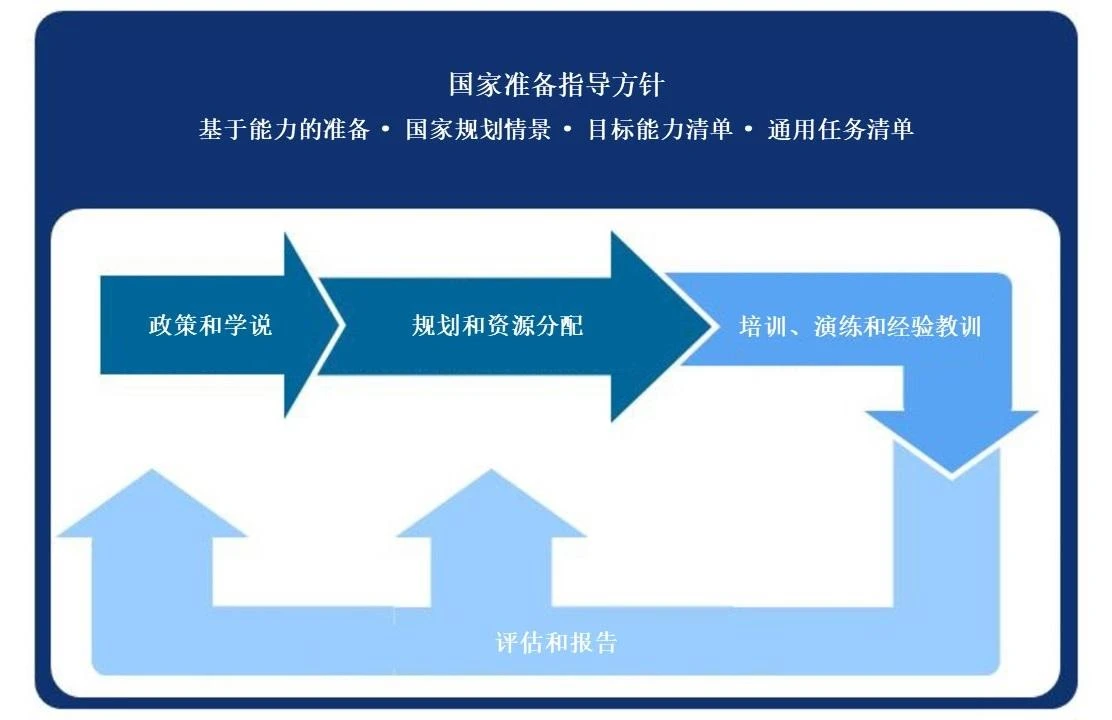
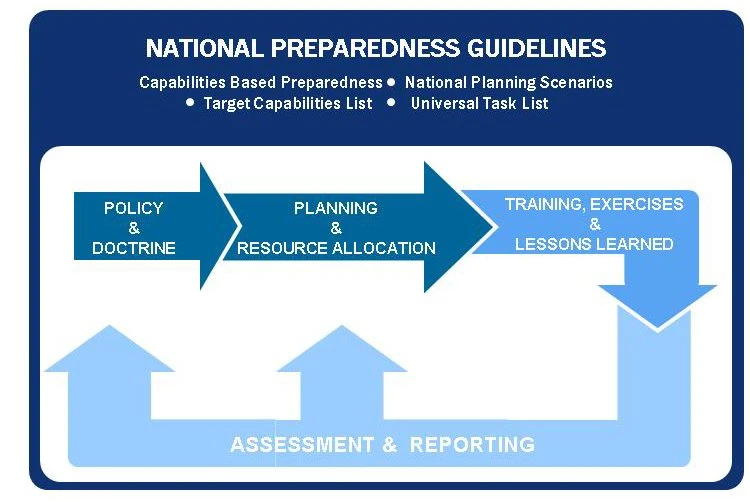
国家准备系统包含以下四个关键组成部分:
The National Preparedness System consists of four critical components:
1. 评估风险(Assess Risk) 根据潜在威胁、脆弱性和后果了解国家的风险状况,使用国家规划情景和本地风险评估来识别需要关注的风险领域。
Assess Risk: Understand the Nation’s risk profile in terms of potential threats, vulnerabilities, and consequences, using the National Planning Scenarios and local risk assessments to identify areas of risk that require attention.
2. 确定能力需求(Determine Capability Requirements) 基于对风险的理解,确定国家和地方应对灾难性事件所需的能力类型、数量和熟练程度,使用目标能力清单作为国家基准。
Determine Capability Requirements: Based on the understanding of risk, determine the type, quantity, and proficiency of capabilities needed at the national and local levels to respond to catastrophic events, using the Target Capabilities List as the national baseline.
3. 开发和维护能力(Develop and Maintain Capabilities) 通过应用能力构建周期(计划、组织和配备人员、装备、培训、演练、评估和改进)战略性地开发、维持和增强所需能力。
Develop and Maintain Capabilities: Strategically develop, sustain, and enhance the needed capabilities by applying the capability building cycle (Plan, Organize and Staff, Equip, Train, Exercise, Evaluate, and Improve).
4. 评估和测量就绪度(Assess and Measure Readiness) 以风险为基础,利用就绪度指标和能力评估工具评估准备状态,识别就绪差距,并将结果反馈到规划过程中以指导持续改进。
Assess and Measure Readiness: Evaluate preparedness status on a risk-informed basis using readiness metrics and capability assessment tools, identify readiness gaps, and feed the results back into planning to guide continuous improvement.
这些组成部分共同构成了一个持续的循环过程,使国家能够随着时间的推移评估和改进其准备状态。
Together, these components form a continuous cyclic process that enables the Nation to assess and improve its preparedness posture over time.
6.0 管理和维护 MANAGEMENT AND MAINTENANCE
指导方针是一份具有生命力的文件,将随着国家加强各级政府和私营部门的能力准备而不断演变。国土安全部将负责指导方针的持续管理和维护,包括定期审查和更新指导方针及其支持性工具,以确保它们反映当前威胁环境、汲取经验教训以及国家和地方各级不断变化的准备需求的策略。
The Guidelines are a living document that will evolve as the Nation strengthens preparedness capabilities at all levels of government and within the private sector. DHS will be responsible for the ongoing management and maintenance of the Guidelines, including periodic review and update of the Guidelines and their supporting tools to ensure they reflect the current threat environment, incorporate lessons learned, and address the evolving preparedness needs of the Nation at both the national and local levels.
关键管理活动:
Key Management Activities:
定期审查和更新: 国土安全部将至少每三年对指导方针进行一次全面审查,或根据需要对国家优先事项进行更频繁的审查。这些审查将考虑国家和地方风险评估的变化、新出现的威胁和脆弱性、从实际事件和演练中汲取的经验教训、技术进步以及准备投资的有效性。审查过程将包括联邦、州、地方、部落和领地政府以及私营部门和非政府组织的利益攸关方。
Periodic Review and Update: DHS will conduct a comprehensive review of the Guidelines at least once every three years, or more frequently as needed to update national priorities. These reviews will consider changes in national and local risk assessments, emerging threats and vulnerabilities, lessons learned from real-world events and exercises, technological advances, and the effectiveness of preparedness investments. The review process will include stakeholders from Federal, State, local, tribal, and territorial governments, as well as the private sector and nongovernmental organizations.
工具维护: 目标能力清单(TCL)、国家规划情景和通用任务列表(UTL)等支持性工具将根据需要更新,以反映风险环境的变化和从实践中汲取的经验教训。这些工具的更新将与指导方针的审查过程相协调。
Tool Maintenance: The supporting tools, including the Target Capabilities List (TCL), National Planning Scenarios, and Universal Task List (UTL), will be updated as needed to reflect changes in the risk environment and lessons learned from experience. Updates to these tools will be coordinated with the Guidelines review process.
就绪度评估系统: 国土安全部将建立一个持续的就绪度评估系统,以衡量国家和地方层面在实现国家优先事项方面的进展。该系统将包括就绪度指标、能力评估工具和报告机制,以追踪国家准备能力随时间的改进情况。评估结果将用于指导准备投资和推动目标性的改进工作。
Readiness Assessment System: DHS will establish a continuing readiness assessment system to measure the Nation’s progress in achieving the national priorities at both the national and local levels. This system will include readiness metrics, capability assessment tools, and reporting mechanisms to track the Nation’s improvement in preparedness capabilities over time. Assessment results will be used to guide preparedness investments and drive targeted improvement efforts.
协调和整合: 国土安全部将与其他联邦部门和机构、州和地方官员以及私营部门合作伙伴协调指导方针的实施,以确保与国家准备相关的各种计划和倡议之间的整合,避免重复努力,并优化资源利用。
Coordination and Integration: DHS will coordinate implementation of the Guidelines with other Federal departments and agencies, State and local officials, and private sector partners to ensure integration among the various plans and initiatives related to national preparedness, avoid duplication of effort, and optimize the use of resources.
附录A——指令函 APPENDIX A— Letter of Instruction
国家准备指导方针(指导方针)一经颁布即正式确立,并取代2005年3月31日发布的《临时国家准备目标》。指导方针为塑造国家准备提供了总体愿景、工具和优先事项。指导方针不包括实施计划;随着时间的推移,将通过广泛的联邦、州、地方、部落和领地准备项目和活动来实施。例如,联邦项目办公室将支持指导方针的实施,制定详细的计划描述他们的项目如何与利益相关者协商。这些细节必须以可测量的目标和要求的形式反映在年度项目指南中。DHS将监督这些工作,并向项目办公室和DHS领导层提出进展情况和改善同步机会的建议。实施情况和反馈将为今后完善指导方针提供信息。
The National Preparedness Guidelines (Guidelines) are formally established upon issuance and supersede the Interim National Preparedness Goal issued on March 31, 2005. The Guidelines provide an overarching vision, tools, and priorities to shape national preparedness. The Guidelines do not include an implementation plan; implementation will occur over time through a wide range of Federal, State, local, tribal, and territorial preparedness programs and activities. For example, Federal program offices will develop detailed plans that describe how their programs support Guidelines implementation in consultation with their stakeholders. Those details must be reflected in annual program guidance, in the form of measurable objectives and requirements. DHS will monitor those efforts and advise program offices and DHS leadership on progress and opportunities to improve synchronization. Implementation and feedback will inform future refinement of the Guidelines.
要求 Requirements
本节概述了联邦、州、地方、部落和领地政府、非政府组织、私营部门和公民在实施指导方针概述的准备框架方面的作用和责任。具体而言,本节提供了潜在活动的示例,旨在概述前进的道路。在法律允许的范围内,接受联邦准备援助的要求、年度联邦项目指南和联邦法规的变化也将支持指导方针的实施。许多项目和活动已经与指导方针保持一致,只需要在更密切的协调下实施。HSPD-8中没有改变或阻碍政府官员依法履行职责的能力。
This section outlines roles and responsibilities of Federal, State, local, tribal, and territorial governments, nongovernmental organizations, the private sector, and citizens in implementing the preparedness framework outlined by the Guidelines. Specifically, this section provides examples of potential activities for the purpose of outlining the way forward. Guidelines implementation will also be supported by changes in requirements for receiving Federal preparedness assistance, annual Federal program guidance, and Federal regulations to the extent permitted by law. Many programs and activities are already consistent with the Guidelines and simply need to be implemented in closer coordination. Nothing in HSPD-8 alters or impedes the ability of government officials to perform their responsibilities under law.
国土安全部 Department of Homeland Security
作为实施指导方针概述的准备框架的牵头机构,DHS应做以下工作:
- 协调建立管理和维护指导方针的结构和过程,包括基于能力的准备工具和评估系统;
- 如HSPD-8所述,协调与以下相关的联邦部门和机构与指导方针的一致性:
- 联邦准备援助;
- 第一响应者设备标准;
- 准备研究和发展活动;
- 联邦培训项目;
- 国家演练项目;
- 机构间规划过程;
- 国家准备工作的绩效测量;
- 相关联邦监管要求;和
- 支持州、地方、领地和部落政府运作的联邦资产。
- 酌情满足其他HSPD-8要求。
As the lead for implementation of the preparedness framework outlined by the Guidelines, DHS shall do the following:
- Coordinate the establishment of a management and maintenance structure and process for the Guidelines, including the Capabilities-Based Preparedness tools and the assessment system;
- As outlined in HSPD-8, coordinate consistency with the Guidelines among Federal departments and agencies associated with the following:
- Federal preparedness assistance;
- First responder equipment standards;
- Preparedness research and development activities;
- Federal training programs;
- National Exercise Program;
- Interagency planning processes;
- Performance measurements for national preparedness;
- Relevant Federal regulatory requirements; and
- Federal assets in support of State, local, territorial, and tribal government operations.
- Address other HSPD-8 requirements, as appropriate.
州、地方、部落和领地政府以及非政府组织 State, Local, Tribal, and Territorial Governments and Nongovernmental Organizations
鼓励州、地方、部落和领地政府以及非政府组织采取以下行动:
- 参与制定和实施管理和维护指导方针的结构和过程,包括基于能力的准备工具和评估系统;
- 通过确定其能力水平和各自的要求,并在项目计划和指导文件的制定中提供咨询,参与指导方针的实施;
- 采用类似于附录B中所述类似的循序渐进地能力准备过程,确保其各自的国土安全项目以与指导方针保持一致和加强国家优先事项的方式进行管理;
- 参与区域举措,以确定和同步现有和未来可能通过互助协议获得的能力;
- 为员工明确适当的支持角色,使其作为应急人员履行能力,并支持能力清单的开发和维护;和
- 酌情满足其他HSPD-8要求。
State, local, tribal, and territorial governments and nongovernmental organizations are encouraged to do the following:
- Participate in the development and implementation of the management and maintenance structure and process for the Guidelines, including the Capabilities-Based Preparedness tools and the assessment system;
- Participate in Guidelines implementation by ascertaining their capability levels and their respective requirements, and by consulting in the development of program plans and guidance documents;
- Adopt a step-by-step capability preparedness process similar to that described in Appendix B to ensure that their respective homeland security programs are administered in a manner that is consistent with the Guidelines and enhance the National Priorities;
- Participate in regional initiatives to identify and synchronize the availability of existing and future capabilities that may be accessible through mutual aid agreements;
- Define appropriate support roles for employees to perform as emergency staff to fulfill capabilities, and support the development and maintenance of an inventory of capabilities; and
- Address other HSPD-8 requirements as appropriate.
私营部门 Private Sector
如HSPD-8所述,鼓励适当的私营部门实体采取以下行动:
- 将人员和资产的安全保障纳入业务计划和公司战略;
- 参与制定和实施管理和维护指导方针的结构和过程,包括基于能力的准备工具和评估系统;
- 通过确定需求和实现能力,以及在项目计划和指导文件的制定中提供咨询,参与指导方针的实施;
- 参与州、地方、部落、领地和区域的规划和评估过程,以符合指导方针和TCL;和
- 酌情满足其他HSPD-8要求。
As stated in HSPD-8, appropriate private sector entities are encouraged to do the following:
- Incorporate the safety and security of people and assets into business plans and corporate strategies;
- Participate in the development and implementation of the management and maintenance structure and process for the Guidelines, including the Capabilities-Based Preparedness tools and the assessment system;
- Participate in Guidelines implementation by determining requirements and achieving capabilities, and by consulting in the development of program plans and guidance documents;
- Participate in State, local, tribal, territorial, and regional planning and assessment processes to comply with the Guidelines and TCL; and
- Address other HSPD-8 requirements as appropriate.
如HSPD-7所述,鼓励私营部门实体采取以下行动:
- 与相关特定部门机构合作,根据国家基础设施保护计划确定、优先考虑和协调关键基础设施和关键资源的保护;和
- 共享有关物理和网络威胁、脆弱性、事件、潜在保护措施和有效实践的信息。
As stated in HSPD-7, private sector entities are encouraged to do the following:
- Work with the relevant Sector-Specific Agencies to identify, prioritize, and coordinate the protection of critical infrastructure and key resources in conformance with the National Infrastructure Protection Plan; and
- Share information about physical and cyber threats, vulnerabilities, incidents, potential protective measures, and effective practices.
联邦部门和机构 Federal Departments and Agencies
为支持联邦在实施指导方针中概述的准备框架方面的作用,联邦部门和机构(包括DHS)应采取以下行动:
- 支持并参与为指导方针、相关工具和基于能力的准备过程而开发的管理和维护的结构和过程;
- 启动或重新确定项目和举措(以及可测量的目标),以实施指导方针。建议联邦部门和机构使用以下分步过程,确保其各自的国土安全援助项目与指导方针保持一致和加强国家优先事项的方式进行管理。此过程描述将随着时间的推移与用户反馈进行完善,并在必要时和提出要求时补充具体说明。本过程无意取代或阻碍部门或机构决定如何修改个别项目和举措以帮助实施指导方针的自主权:
- 步骤1:分析指导方针并识别适用项目 — 审查指导方针以了解国家准备的意图、方向和要求。识别适用于指导方针的准备项目,包括应对卡特里娜飓风经验教训的举措。如果项目或举措的目标支持任何国家优先事项或TCL中确定的能力,则适用于指导方针。适用的项目和举措可能包括向联邦、州、地方、部落、领地、非政府或私营部门实体提供拨款、培训、演练、设备、技术援助和响应能力。各部门和机构将定期更新并向DHS通报(按要求)这些项目和举措的清单,以及它们在支持指导方针方面的状态。这些信息将用于向总统提交的关于国家准备的年度报告;
- 步骤2:评估计划和指导方针的一致性 — 评估每个适用项目或举措提供的服务,以确定其与指导方针的一致性。有关项目和举措的细节应与DHS和国土安全委员会(HSC)共享和协调,以确保实施指导方针的整合方法和行动计划。HSC负责协调国家国土安全政策的制定。DHS,在HSC的监督下,负责协调联邦部门和机构之间国土安全项目和年度项目指导的制定和实施。合规的联邦项目应明确相互关联和互补的目标、时间表和要求,旨在与指导方针同步;
- 步骤3:使指导方针的实施与预算和项目时间表保持一致 — 联邦部门和机构应尽最大可能修改适用的项目计划和政策,以与指导方针保持一致。联邦部门和机构应当将无法在下一个预算周期内完成的项目改正通知DHS,并应以符合其总体任务优先事项的方式开始在未来年度预算周期内实施改正的进程;
- 步骤4:修改适用项目 — 每个适用项目的运作应当与指导方针一致。为与指导方针保持一致,可能需要对适用项目的管理、目的、目标、随附指南、出版材料、许可用途、申请流程、奖励标准和其他组成部分进行改正。符合性还需要在相关适用项目中整合TCL中概述的可量化的准备和绩效措施,包括申请、奖励标准和项目评估,以监测项目的进展及其受益人,从而推进指导方针。联邦部门和机构应当修改申请和授予过程,以采用基于能力的准备程序(见附录B),并监督和报告适用的国土安全计划的应用,以促进指导方针和TCL中规定的优先事项和能力;
- 步骤5:通知利益相关方 — 只要可行,尽快将修正及其与指导方针、TCL和国家倡议的对应关系通知所有适用的合作伙伴和适用的准备和响应计划的受益者。该通知还可能包括征求意见和建议,以便将来修改指导方针和TCL;
- 步骤6:维护 — 监督控适用项目的管理,以确保它们支持指导方针。参与DHS的管理和维护过程,向DHS提交建议和意见。意见可以包括对指导方针适用项目进行改革的功能,并应当明确指出与其他正在进行的举措的不一致之处、实施困难,并建议对TCL进行修改,以确保它代表测量国家准备的最新手段。各机构应当确定如何收集有关项目优先事项、绩效指标和能力评估的相关数据,并将其与国家报告工作相结合;
- 支持开发和维护联邦项目清单,支持指导方针中规定的能力;和
- 酌情满足其他HSPD-8要求。
To support the Federal role in implementing the preparedness framework outlined in the Guidelines, Federal departments and agencies (including DHS) shall do the following:
- Support and participate in the management and maintenance structure and process developed for the Guidelines, associated tools, and Capabilities-Based Preparedness process;
- Initiate or re-orient programs and initiatives (along with measurable objectives) to implement the Guidelines. The following step-by-step process is suggested for use by Federal departments and agencies to ensure that their respective homeland security assistance programs are administered in a manner that is consistent with the Guidelines and enhances the National Priorities. This process description will be refined over time with user feedback and supplemented with specific instructions, if necessary and if requested. This process is not intended to substitute or impede department or agency autonomy for determining how individual programs and initiatives will be modified to help implement the Guidelines:
- Step 1: Analyze the Guidelines and Identify Applicable Programs – Review the Guidelines to understand the intent, direction, and requirements for national preparedness. Identify preparedness programs – including initiatives to address Hurricane Katrina Lessons Learned – that are applicable to the Guidelines. A program or initiative is applicable to the Guidelines if its objectives support any of the National Priorities or the capabilities identified in the TCL. Applicable programs and initiatives may consist of grants, training, exercises, equipment, technical assistance, and response capabilities to Federal, State, local, tribal, territorial, nongovernmental, or private sector entities. Departments and agencies will periodically update and communicate to DHS (as requested) this inventory of programs and initiatives, along with their status in supporting the Guidelines. This information will be used for the Annual Report to the President on National Preparedness;
- Step 2: Assess Program and Guidelines Consistency – Assess the services provided by each applicable program or initiative to determine their consistency with the Guidelines. Details on relevant programs and initiatives should be shared and coordinated with DHS and the Homeland Security Council (HSC) to ensure an integrated approach and action plan for Guidelines implementation. The HSC is responsible for coordinating the development of national homeland security policy. DHS, with oversight from the HSC, is responsible for coordinating the development and implementation of homeland security program plans and annual program guidance among Federal departments and agencies. Compliant Federal programs shall define interconnected and complementary objectives, timelines, and requirements designed to synchronize with the Guidelines;
- Step 3: Align Guidelines Implementation with Budget and Program Schedules – To the greatest extent possible, Federal departments and agencies should modify applicable program plans and policies to be consistent with the Guidelines. Federal departments and agencies should notify DHS of program reforms that cannot be completed in the upcoming budget cycle and should begin the process for implementing reforms in future-year budget cycles in a manner that comports with their overall mission priorities;
- Step 4: Modify Applicable Programs – Each applicable program should conform its operations to be consistent with the Guidelines. Conformance with the Guidelines may warrant reforms to the administration, goals, objectives, accompanying guidance, published materials, permitted uses, application process, award criteria, and other components of the applicable program. Conformance will also necessitate the integration of quantifiable preparedness and performance measures outlined in the TCL within relevant applicable programs – including applications, award criteria, and project evaluations – to monitor the progress of the program and its beneficiaries to advance the Guidelines. Federal departments and agencies should modify application and award processes to adopt the Capabilities-Based Preparedness process (See Appendix B) and to monitor and report the application of applicable homeland security programs in furtherance of the priorities and capabilities set forth in the Guidelines and TCL;
- Step 5: Notify Stakeholders – As soon as it is practicable, notify all appropriate partners and beneficiaries of the applicable preparedness and response programs about the reforms and their corresponding relationship to the Guidelines, TCL, and national initiatives. Such notice may also include a solicitation of comments and suggestions for future changes to the Guidelines and TCL;
- Step 6: Maintenance – Monitor the administration of the applicable programs to ensure that they support the Guidelines. Participate in the DHS management and maintenance process by submitting suggestions and comments to DHS. Comments may include any function of reforming applicable programs to the Guidelines and should specifically identify inconsistencies with other ongoing initiatives, implementation difficulties, and recommended modifications to the TCL to ensure that it represents the most current means of measuring national preparedness. Agencies should identify how relevant data on program priorities, performance measures, and capability assessments will be collected and integrated with national reporting efforts;
- Support the development and maintenance of an inventory of Federal programs that support capabilities outlined in the Guidelines; and
- Address other HSPD-8 requirements as appropriate.
公民 Citizens
根据HSPD-8的指示,DHS将与各级政府、非政府组织和私营部门合作,鼓励公民积极参与准备。DHS与联邦、州、地方、部落和领地政府以及私营和非营利部门一起,应集中精力实现以下:
- 整合公民参与全国国土安全的工作并制度化;
- 通过公民团委员会等机制,促进所有社区资源(公民、非政府组织、私营部门和宗教组织)与各级政府的准备工作的合作和整合,开展意识和宣传活动,传递”准备、培训和志愿服务”的个人责任信息,从而支持准备文化,并激励所有美国人采取行动,降低脆弱性,增强韧性;
- 通过社区应急小组、医疗预备队、消防队、警察志愿服务、邻里守望、公民学院、有备儿童和有备企业等项目,鼓励公民培训和志愿者机会;
- 关注特殊需求人群,如残疾人、语言和文化差异、经济障碍以及与年龄相关的问题和关切;
- 制定公民准备和参与的标准、认可激励措施以及评估和评价标准;
- 分享全国各地社区的经验教训和有效实践;和
- 确定内阁部长和其他杰出的公众人物作为发言人,促进公民和社区的准备工作。
As directed in HSPD-8, DHS will work with all levels of government, nongovernmental organizations, and the private sector to encourage active citizen participation and involvement in preparedness. DHS along with Federal, State, local, tribal and territorial governments, and private and nonprofit sectors should focus on efforts to accomplish the following:
- Integrate and institutionalize citizen participation in all homeland security efforts nationwide;
- Support a culture of preparedness by fostering collaboration and integration of all community resources (citizens, nongovernmental organizations, private sector, and faith-based organizations) with preparedness efforts at all levels of government through mechanisms, such as Citizen Corps Councils, to conduct awareness and outreach campaigns to deliver the message of personal responsibility to “prepare, train, and volunteer,” and to motivate all Americans to take action to reduce their vulnerability and increase resilience;
- Encourage citizen training and volunteer opportunities through programs such as Community Emergency Response Teams, Medical Reserve Corps, Fire Corps, Volunteers in Police Service, Neighborhood Watch, Citizens’ Academy, Ready Kids, and Ready Business;
- Focus on special needs populations, such as people with disabilities, language and cultural differences, economic barriers, and age-related issues and concerns;
- Develop standards, recognition incentives, and assessment and evaluation criteria for citizen preparedness and participation;
- Share lessons learned and effective practices from communities around the country; and
- Identify Cabinet Secretaries and other prominent public figures to serve as spokespersons to promote citizen and community preparedness.
附录B——基于能力的准备概述 APPENDIX B— Capabilities-Based Preparedness Overview
《国家准备指导方针》(指导方针)得到了基于能力的重大事件规划方法的支持。基于能力的准备是全危险规划的一种形式。本附录提供了基于能力的准备的综述,并概述了联邦、州、地区和地方的准备项目在全国范围内采用基于能力的准备并制度化时可以使用的过程。它分为三个部分:
- 定义
- 指导方针中引用的规划工具
- 基于能力的准备过程
The National Preparedness Guidelines (Guidelines) are supported by a capabilities-based approach to planning for major events. Capabilities-Based Preparedness is a form of all-hazards planning. This Appendix provides an overview of Capabilities-Based Preparedness and outlines a process that Federal, State, regional, and local preparedness programs can utilize as Capabilities-Based Preparedness is adopted and institutionalized nationwide. It is organized into three sections:
- Definition
- Planning Tools Referenced in the Guidelines
- Capabilities-Based Preparedness Process
定义 Definition
基于能力的准备定义为: 在不确定的情况下,准备提供适于各种挑战的能力,同时在需要确定优先次序和选择的经济框架内工作。
Capabilities-Based Preparedness is defined as: …preparing, under uncertainty, to provide capabilities suitable for a wide range of challenges while working within an economic framework that necessitates prioritization and choice.
基于能力的准备是一种就如何管理风险和减少潜在威胁造成的影响做出明智选择的方法。它将决策重点放在建立和保持预防和抵御挑战的能力(例如,情报分析、关键基础设施保护等),以及在事件发生时做出响应和恢复的能力(例如,现场事件管理、医疗激增、紧急公共信息和经济恢复等)。
Capabilities-Based Preparedness is a way to make informed choices about how to manage the risk and reduce the impact posed by potential threats. It focuses decision making on building and maintaining capabilities to prevent and protect against challenges (e.g., intelligence analysis, critical infrastructure protection, etc.) and to respond and recover when events occur (e.g., onsite incident management, medical surge, emergency public information, and economic recovery).
该过程建立在多学科、跨政府和区域合作的基础上,以确定可测量的能力目标,评估当前的能力水平,并找到缩小差距的方法。随着实体在准备项目和活动中做出选择,它们将能够改进自身的准备,将现有援助重点放在最需要的领域,并使用共同的参考框架与其他机构合作。
The process rests on a foundation of multi-disciplinary, cross-governmental, and regional collaboration to determine measurable capability targets, to assess current levels of capabilities, and to find ways to close the gaps. As entities make choices in preparedness programs and activities, they will be able to improve their own preparedness, focus available assistance on areas of greatest need, and collaborate with others using a common reference framework.
能力被定义为提供: ……在特定条件下,通过执行关键任务达到目标绩效水平,从而完成使命或功能并获得预期结果的手段。
Capabilities are defined as providing: …the means to accomplish a mission or function and achieve desired outcomes by performing critical tasks, under specified conditions, to target levels of performance.
指导方针中提到的37项能力涵盖了国土安全使命的所有方面。虽然该清单还没有涵盖预防、保护、响应或从重大事件中恢复而必须完成的所有功能,但它仍然为规划提供了一个全面的起点。每种能力都在指导方针附带的目标能力清单(TCL)中详细描述。描述包括定义、结果、准备和执行活动、任务和度量。
The 37 capabilities referenced in the Guidelines span the full spectrum of homeland security missions. While the listing does not yet encompass every function that must be accomplished to prevent, protect against, respond to, or recover from a major event, it nonetheless offers a comprehensive starting point for planning. Each capability is described in detail in the Target Capabilities List (TCL), which accompanies the Guidelines. The description includes a definition, outcome, preparedness and performance activities, tasks, and measures.
指导方针中引用的规划工具 Planning Tools Referenced in the Guidelines
国家准备指导方针利用并参考了3种基于能力的准备工具:国家规划情景、TCL和通用任务清单(UTL)。
The National Preparedness Guidelines utilize and reference three Capabilities-Based Preparedness tools: the National Planning Scenarios, the TCL, and the Universal Task List (UTL).
国家规划情景 National Planning Scenarios
虽然准备适用于全危险的范围,但《国土安全国家战略》(2002年)特别强调为”大规模伤亡、巨大财产损失和巨大社会破坏的最大风险”的灾难性威胁做准备。为了说明一系列重大事件的潜在范围、规模和复杂性,国土安全委员会与国土安全部(DHS)、其他联邦部门和机构以及州、地方、部落和领地政府合作,开发了国家规划情景。这15种情景包括恐怖袭击、重大灾难和其他紧急情况。如图B-1所示。
While preparedness applies across the all-hazards spectrum, the 2002 National Strategy for Homeland Security attaches special emphasis to preparing for catastrophic threats with “the greatest risk of mass casualties, massive property loss, and immense social disruption.” To illustrate the potential scope, magnitude, and complexity of a range of major events, the Homeland Security Council—in partnership with the Department of Homeland Security (DHS), other Federal departments and agencies, and State, local, tribal, and territorial governments— developed the National Planning Scenarios. The 15 Scenarios include terrorist attacks, major disasters, and other emergencies. They are listed in Figure B-1.
图B-1:国家规划情景(Figure B-1: National Planning Scenarios)
| 情景 Scenario | 情景 Scenario |
|---|---|
| 简易核装置 Improvised Nuclear Device | 大地震 Major Earthquake |
| 炭疽气溶胶 Aerosol Anthrax | 大飓风 Major Hurricane |
| 大流行性流感 Pandemic Influenza | 放射性散布装置 Radiological Dispersal Device |
| 瘟疫 Plague | 简易爆炸装置 Improvised Explosive Device |
| 糜烂性毒剂 Blister Agent | 食品污染 Food Contamination |
| 有毒工业化学品 Toxic Industrial Chemicals | 外来动物疾病 Foreign Animal Disease |
| 神经毒剂 Nerve Agent | 网络攻击 Cyber Attack |
| 氯容器爆炸 Chlorine Tank Explosion | 经济破坏 Economic Disruption |
各级政府可以使用国家规划情景作为参考,探索重大事件的潜在后果,并评估和提高其执行指定使命和任务的能力。不排除规划者开发自己的情景来补充国家规划情景。DHS将维护国家规划情景组合,并根据国土安全战略环境的变化定期更新。目前的版本可在国内准备办公室安全门户网站 (https://odp.esportals.com)以及经验教训信息共享系统(https://www.llis.dhs.gov)上获得。在联邦资助的培训和演练中使用特定的国家规划场景将在项目指南中加以说明。
All levels of government can use the National Planning Scenarios as a reference to explore the potential consequences of major events and to evaluate and improve their capabilities to perform their assigned missions and tasks. Planners are not precluded from developing their own scenarios to supplement the National Planning Scenarios. DHS will maintain a National Planning Scenario portfolio and update it periodically based on changes in the homeland security strategic environment. The current version is available on the Office of Domestic Preparedness (ODP) Secure Portal (https://odp.esportals.com) and the Lessons Learned Information Sharing system (https://www.llis.dhs.gov). Use of specific National Planning Scenarios in federally funded training and exercises will be addressed in program guidance.
目标能力清单 Target Capabilities List
根据相关的风险和威胁,TCL识别和定义国家可能需要实现和维持的能力,以便做好准备。能力可以借由合理规划、组织、装备、培训和演练的人员实现预期结果的任何组合而得到。各实体应发展和保持反映全国不同风险和需求水平的能力。
The TCL identifies and defines capabilities that the Nation may need to achieve and sustain, depending on relevant risks and threats, in order to be prepared. A capability may be delivered with any combination of properly planned, organized, equipped, trained, and exercised personnel that achieves the desired outcome. Entities are expected to develop and maintain capabilities at levels that reflect the differing risk and needs across the country.
每种能力都包括对该能力中执行的主要活动的描述,以及与活动相关的关键任务和度量。关键任务是指在重大事件期间必须执行的任务,以最大限度地减少对生命、财产和经济的影响。关键任务在执行过程中可能需要联邦、州、地方、部落、领地、私营部门和/或非政府实体之间的协调。它们对于取得预期结果和国土安全使命的成功至关重要。关键任务来源于UTL中找到的任务。关键任务,当与操作条件和绩效标准相联系时,为培训和演练提供学习目标的主要来源,并为规划和绩效评价提供输入。操作条件是环境的变量,如地形、天气、对手的存在以及多机构关系的复杂性,这些都可能影响绩效。TCL包括定量或定性级别的度量和指标,可以根据这些来评估任务或能力结果的实现情况。
Each capability includes a description of the major activities performed within the capability and the critical tasks and measures associated with the activity. Critical tasks are those tasks that must be performed during a major event in order to minimize the impact on lives, property, and the economy. Critical tasks may require coordination among Federal, State, local, tribal, territorial, private sector, and/or nongovernmental entities during their execution. They are essential for achieving the desired outcome and successful homeland security missions. Critical tasks are derived from tasks found in the UTL. Critical tasks, when paired with conditions and performance standards, serve as the primary source for learning objectives for training and exercises, as well as input for planning and performance evaluation. Conditions are variables of the environment, such as terrain, weather, presence of adversaries, and complexity of multi-agency relationships, that can affect performance. The TCL includes measures and metrics at the quantitative or qualitative levels against which the achievement of a task or capability outcome can be assessed.
通用任务列表 Universal Task List
UTL是一个包含所有国土安全使命领域的任务及其下属任务的中央存储库和分层目录。UTL包含约1,600项独特的任务,涵盖了预防、保护、响应和恢复。UTL提供了一个通用的词汇和任务基线,国家和各级组织可以在制定计划和互操作性评估以及确定投资优先级时参考。虽然没有任何一个组织会执行每一项任务,但UTL提供了一个共同的参考框架,每个实体都可以根据其使命和职责从中选择相关的任务。UTL为国家规划情景、TCL的开发提供了信息,并为与其他实体协调和整合提供了基础。
The UTL is a central repository and hierarchical directory of tasks and sub-tasks across all homeland security mission areas. The UTL contains approximately 1,600 unique tasks covering prevention, protection, response, and recovery. The UTL provides a common vocabulary and task baseline to be referenced by the Nation and organizations at all levels in the creation of plans and interoperability assessments and for determining investment priorities. While no single organization will perform every task, the UTL provides a common reference framework from which each entity can select relevant tasks based on its mission and responsibilities. The UTL informed the development of the National Planning Scenarios, the TCL, and provides the basis for coordination and integration with other entities.
基于能力的准备过程 Capabilities-Based Preparedness Process
基于能力的准备包括一个8步过程,该过程利用国家规划情景、TCL和UTL在国家准备工作中建立通用标准。开发该过程是为了帮助各管辖区规划、评估和发展能力,以应对所有潜在威胁和危险。该过程如下所述。请注意,对于管理区而言,并行开展其中几个步骤可能是明智且高效的。
Capabilities-Based Preparedness consists of an 8-step process that leverages the National Planning Scenarios, TCL, and UTL in establishing common standards throughout national preparedness efforts. The process was developed to help jurisdictions plan, assess, and develop capabilities for responding to the full range of potential threats and hazards. The process is described below. Note that it might be prudent and efficient for a jurisdiction to conduct several of these steps in parallel.
基于能力的准备过程(8步过程)Capabilities-Based Preparedness Process (8-Step Process)
| 步骤 Step | 活动 Activity |
|---|---|
| 第1步:确定指导方针要求 Step 1: Identify Guidelines Requirements | 评估国家优先事项、国家规划情景、目标能力清单和通用任务列表,以了解应用于本组织的国家准备要求。 Review the National Priorities, National Planning Scenarios, Target Capabilities List, and Universal Task List to understand the national preparedness requirements that apply to the organization. |
| 第2步:进行威胁和风险评估 Step 2: Conduct Threat and Risk Assessment | 基于国家规划情景和本地数据,评估具体的威胁、脆弱性和后果,以确定组织的风险状况。 Assess specific threats, vulnerabilities, and consequences based on the National Planning Scenarios and local data to determine the organization’s risk profile. |
| 第3步:评估当前能力 Step 3: Assess Current Capabilities | 对照目标能力清单中定义的能力基准,评估组织当前的能力水平和就绪状态,识别能力和就绪差距。 Assess the organization’s current capability levels and readiness status against the capability baselines defined in the Target Capabilities List, identifying capability and readiness gaps. |
| 第4步:确定和优先排序能力差距 Step 4: Identify and Prioritize Capability Gaps | 基于风险评估结果,确定能力差距的优先级,重点关注对最高风险领域最关键的能力。 Prioritize capability gaps based on risk assessment findings, focusing on capabilities most critical to the highest risk areas. |
| 第5步:制定战略和计划 Step 5: Develop Strategies and Plans | 制定解决已识别能力优先差距的战略和计划,包括确定所需资源、设定目标日期和建立实施里程碑。 Develop strategies and plans to address identified priority capability gaps, including identifying needed resources, setting target dates, and establishing implementation milestones. |
| 第6步:实施战略和计划 Step 6: Implement Strategies and Plans | 分配资源并执行计划,以弥补识别的能力差距,包括获取设备、培训人员和建立必要的系统和结构。 Allocate resources and execute plans to close identified capability gaps, including acquiring equipment, training personnel, and establishing necessary systems and structures. |
| 第7步:评估和测量就绪度 Step 7: Assess and Measure Readiness | 通过演练、实际事件和就绪度评估工具评估能力就绪状态,以衡量进展并识别持续存在的或新出现的差距。 Assess capability readiness through exercises, real-world events, and readiness assessment tools to measure progress and identify remaining or emerging gaps. |
| 第8步:持续改进 Step 8: Continuous Improvement | 将从评估中汲取的经验教训反馈到规划过程中,更新风险评估和计划,并不断改进能力以应对变化的环境。 Feed lessons learned from assessments back into the planning process, update risk assessments and plans, and continuously improve capabilities to address the changing environment. |
第1步:确定指导方针要求 Step 1: Identify Guidelines Requirements
各实体首先了解和记录适用于其组织的国家准备要求。这一步包括审查国家优先事项、国家规划情景、目标能力清单(TCL)和通用任务清单(UTL)。该审查建立了一个基线,用于评估从第3步开始的能力。在进行这一初始审查时,各实体应建立一个工作组来监督这项准备工作。工作组应由组织中参与应急准备和响应的所有实体的代表组成,并应包括适当的利益相关者,如来自州、地方、部落、领地、私营部门和非政府组织的代表。成立工作组的目的是在基于能力的准备过程的所有步骤中进行协调和取得投入。
Entities first understand and document the national preparedness requirements that apply to their organization. This step involves reviewing the National Priorities, National Planning Scenarios, the Target Capabilities List (TCL), and the Universal Task List (UTL). This review establishes a baseline for assessments to follow, beginning with Step 3. In conducting this initial review, entities should establish a working group to oversee the preparedness effort. The working group should consist of representatives from all entities within the organization that are involved in emergency preparedness and response, and should include appropriate stakeholders such as representatives from State, local, tribal, territorial, private sector, and nongovernmental organizations. The working group’s purpose is to coordinate and obtain input across all steps of the Capabilities-Based Preparedness process.
第2步:进行威胁和风险评估 Step 2: Conduct Threat and Risk Assessment
为了确定能力的优先顺序,各实体应进行威胁和风险评估,以了解其独特的风险状况。评估结果将确保能力投资针对最重大的风险。执行威胁和风险评估的方法有很多。无论采用何种方法,各实体都应评估并记录其威胁环境、脆弱性和后果。具体而言,实体应考虑其风险与指导方针中确定的国家规划情景的相关性,并使用来自该分析的、经过本地评估情况进行调整的信息来补充来自本地评估的信息。结果应用作确定优先事项的基础,并用于为第3步中评估的能力选择提供信息。
In order to prioritize capabilities, entities should conduct a threat and risk assessment to understand their unique risk profile. Assessment results will ensure capability investments are targeted to the most significant risks. There are numerous methodologies for performing threat and risk assessments. Regardless of the methodology used, entities should evaluate and document their threat environment, vulnerabilities, and consequences. Specifically, entities should consider the applicability of their risk to the National Planning Scenarios identified in the Guidelines and use information from that analysis, modified by an assessment of local conditions, to supplement information from local assessments. The results should be used as the basis for determining priorities and to inform the selection of capabilities that will be evaluated in Step 3.
第3步:评估当前能力水平 Step 3: Assess Current Capability Levels
基于能力的准备方法的核心是将当前能力与基于风险的目标能力水平进行比较。工作组将协调对当前能力水平的评估。能力评估根据适用于各级政府的TCL目标能力水平来衡量当前的能力水平。比较将揭示”差距”(意味着现有能力无法实现结果)、“过剩”(不必要的冗余或不再需要的能力)和”不足”(现有能力不足以为特定情景的成功提供合理保证)。一些所需的能力和专门知识在州或管辖区内不存在。许多将通过区域多机构协调(即互助、通过合同获取以及来自非政府和私营部门合作伙伴的资源)获得保障。
The core of the Capabilities-Based Preparedness approach is the comparison of current capabilities with risk-based target capability levels. The working group will coordinate an assessment of the current levels of capability. Capability assessments measure the current level of capability against the target levels of capability from the TCL applicable to the respective level of government. Comparisons will reveal “gaps” (implying outcomes cannot be accomplished with current capabilities), “excesses” (unnecessary redundancies or no longer needed capabilities), and “deficiencies” (an existing capability that is insufficient to provide a reasonable assurance of success against a specified scenario). Some of the required capabilities and expertise will not be present in the State or jurisdiction. Many will be secured through regional multi-agency coordination (i.e., mutual aid, acquisition through contracting, and resources from nongovernmental and private sector partners).
第4步:识别、分析和选择选项 Step 4: Identify, Analyze, and Choose Options
基于能力的准备还包括选择解决能力差距和不足的方法。这个步骤包括将能力差距或不足转化为具体需求,并确定满足需求的资源组合。在此步骤中应用了使用比较、权衡和风险分析的分析过程。认识到通常有不止一种资源组合可以解决能力差距或不足,因此分析包括识别、分析和选择选项,使用TCL中确定的推荐资源作为指导。该分析为高级决策者提供了针对每个能力差距或不足的资源或解决方案集的可选组合。分析组件描述如下。
Capabilities-Based Preparedness also involves selecting methods to address capability gaps and deficiencies. This step involves translating a capability gap or deficiency into specific needs and determining a combination of resources to fulfill the need. Analytical processes using comparative, trade-off, and risk analyses are applied in this step. Recognizing that there is usually more than one resource combination that can address a capability gap or deficiency, the analysis includes identifying, analyzing, and choosing options, using the recommended resources identified in the TCL as a guide. This analysis provides senior decision-makers with alternative combinations of resources or solution sets for each capability gap or deficiency. Analysis components are described below.
识别选项 所识别的选项范围应保持在可管理的数量上,但是解决方案应根据实现能力所需的要素来构建。能力可以借由合理规划、组织、装备、培训和演练人员实现预期结果的任何组合而得到。在审查选项时,应考虑在地理区域和各级政府之间实施互助的有效性。
Identify Options. The range of options identified should be kept to a manageable number, but solutions should be framed in terms of the elements required to implement a capability. A capability may be delivered with any combination of properly planned, organized, equipped, trained, and exercised personnel that achieves the desired outcome. In reviewing options, the effectiveness of applying mutual aid among geographic regions and levels of government should be considered.
分析选项 一旦识别了一系列选项,就应根据一套标准的准则对每个选项进行分析并确定其优先级。分析将确定能够提供所需能力的资源组合,并将适当地处理风险。准则的示例包括:
- 识别提供所需能力的方法的能力。由于先前的投资,可能没有必要一次投资所有6个要素(见指导方针第5页图3)来实现能力;
- 具备交付全部能力的方法的能力。如果一种方法不能交付全部能力,评估有多少能力被满足;
- 交付时间框架;
- 与现有能力相比,这些方法提供的能力水平有相对的提高;和
- 与维持现有能力的成本相比,开发、获取和维持新方法的成本。
Analyze Options. Once a range of options has been identified, each option should be analyzed and prioritized against a standard set of criteria. The analysis will determine the combination of resources that could provide the desired capability or capabilities and will appropriately address risk. Examples of criteria include the following:
- Ability of the identified approaches to provide the desired capability. Due to prior investments, it may not be necessary to invest in all six elements (see Figure 3 on page 5 of the Guidelines) at one time in order to achieve a capability;
- Ability of the approaches to deliver the total capability. If an approach cannot deliver the total capability, evaluate how much of the capability can be met;
- Delivery time frame;
- Relative improvement in capability level provided by the approaches as compared to the existing capability; and
- Cost to develop, procure, and sustain the approaches versus the cost to sustain the existing capability.
选择选项 分析结果将提交给高级决策者考虑。风险确定是决策过程的一部分。风险确定将考虑能力差距、过剩和不足的范围;在分析期间发现的问题(如分析选项组成部分的准则中发现的);以及战略关切和影响。风险确定还将考虑以下因素:
- 能力结果是否能够达成并提供成功的合理保证?
- 与其他选项相比,潜在成本是多少?所需的成本和时间是否与获得的收益相称?
- 对规划有什么影响?该解决方案是否与通过援助计划提供的其他解决方案兼容,互助是否可以满足要求?
Choose Options. The results of the analysis are presented to senior decision-makers for consideration. Risk determinations are embedded in the decision-making process. Risk determinations will consider the range of capability gaps, excesses, and deficiencies; issues identified during analysis (as identified in the analyze options component criteria); and strategic concerns and implications. Risk determinations will also consider the following:
- Can the capability outcome be accomplished and provide a reasonable assurance of success?
- What are the potential costs compared to other options? Are the costs and time required appropriate for the benefit gained?
- What is the impact on planning? Is the solution compatible with other solutions available through assistance programs, and can mutual aid be applied to meet the requirement?
通过应用已知约束条件并检查所有能力,可以选择一个首选解决方案集。然后,可以将结果整合到所有相关能力的排定优先次序的、平衡的能力组合中。
By applying known constraints and examining all capabilities, a preferred solution set can be selected. The results can then be consolidated into a prioritized, balanced portfolio across all relevant capabilities.
第5步:更新计划和战略 Step 5: Update Plans and Strategies
一旦选择了选项,工作组就可以更新其应急行动计划和准备战略。这些战略应与国家准备指导方针保持一致,并支持和促进区域合作和互助。战略是由具体的年度工作计划支持的多年期规划工具,这些年度工作计划描述了每年实现更长期战略的方法。应更新或修订区域互助协议,资金申请应确定优先的资源需求,并应酌情重新分配现有资源,以弥补能力差距。
Once options are chosen, working groups can update their emergency operations plans and preparedness strategies. The strategies should be aligned with the National Preparedness Guidelines and support and facilitate regional cooperation and mutual aid. Strategies are multi-year planning vehicles supported by specific annual work plans that describe each year’s approach to meeting the longer term strategy. Regional mutual aid agreements should be updated or revised, funding requests should identify prioritized resource needs, and existing resources should be reallocated, as appropriate, to close capability gaps.
第6步:分配资源 Step 6: Allocate Resources
决策者将领导对预算、现有资源和资金申请的审查,并将其与当前或潜在的资金来源相关联。使用基于能力的准备,他们的目标是在每个管辖区内以及在全国范围内,建立一个有效的和区域协调的准备组合。最终,通过完成以下工作,平衡准备组合将有助于国家做好更充分的准备:
- 根据国土安全战略并与国家准备指导方针协调,使准备投资和资源的回报最大化;
- 在一贯适用的标准和决策框架的基础上,明确资源分配决定;和
- 鼓励以区域和/或互助伙伴的方式做好国家准备。
Decision-makers will lead a review of budgets, existing resources, and funding requests and map these to current or potential sources of funding. Using Capabilities-Based Preparedness, their aim is to produce an effective and regionally coordinated preparedness portfolio within each jurisdiction and, as a consequence, across the Nation. Ultimately, balancing the preparedness portfolio will contribute to a more prepared Nation by accomplishing the following:
- Maximizing the return on preparedness investments and resources in compliance with homeland security strategies and in coordination with the National Preparedness Guidelines;
- Providing clarity in resource allocation decisions based on consistently applied criteria and decision-making frameworks; and
- Encouraging a regional and/or mutual aid partner approach to national preparedness.
第7步:更新和执行项目计划 Step 7: Update and Execute Program Plans
先前制定和/或更新的战略和计划通过执行步骤实施。所有有关的利益相关者落实年度工作计划。执行重点如下:
- 管理项目;
- 进行规划和协调;
- 根据成文要求和规定的标准采购设备,并根据需要准备和维护这些设备,使其随时可用;
- 开发和开展培训以填补能力差距;和
- 开发并进行演练以展示绩效。
The strategies and plans previously developed and/or updated are implemented through the execution step. All relevant stakeholders carry out annual work plans. Execution focuses on the following:
- Administering programs;
- Conducting planning and coordination;
- Purchasing equipment in accordance with documented needs and specified standards, as well as preparing and maintaining such equipment to be readily available as needed;
- Developing and conducting training to fill capability gaps; and
- Developing and conducting exercises to demonstrate performance.
以下示例描述了步骤7如何应用于培训和演练。
The following example describes how Step 7 applies to Training and Exercises.
基于能力的培训和演练准备 Capabilities-Based Preparedness for Training and Exercises
| 审查相关战略和政策,以确定需要培训和演练的TCL优先能力 | Review relevant strategy and policy to identify priority TCL capabilities to be trained for and exercised against |
|---|---|
| 为预期的培训和演练活动编制多年期的培训和演练计划和时间表 | Develop a Multi-Year Training and Exercise Plan and Schedule for intended training and exercise activities |
| 根据多年期计划,开展计划的培训活动,以提高TCL的优先能力 | Per the Multi-Year Schedule, carry out planned training activities oriented toward augmenting priority TCL capabilities |
| 开展演练,应用和评估通过培训开发的TCL优先能力 | Conduct exercises that apply and evaluate the priority TCL capabilities developed through training |
| 使用不断升级演练复杂性的”积木式循环”(例如,桌面演练,然后操练,接着是全面演练)来逐步建立TCL的优先能力水平 | Use a “building-block cycle” of escalating exercise complexity (e.g., tabletop exercise, followed by a drill, followed by a full-scale exercise) to incrementally build priority TCL capability levels |
| 使用与每个TCL能力相关的国土安全演练和评价项目演练评价指南来评价演练中测试的能力 | Evaluate capabilities tested in exercises using Homeland Security Exercise and Evaluation Program Exercise Evaluation Guides linked to each TCL capability |
| 每年更新多年期计划,以反映新的优先能力和从演练中吸取的经验教训 | Update Multi-Year Plan annually to reflect new priority capabilities and lessons learned from exercises |
| 有关培训和演练的基于能力的准备规划的更多信息,请参阅国土安全演练和评价项目第一卷:概述和演练项目管理(http://hseep.dhs.gov)。 | For more on Capabilities-Based Preparedness Planning for training and exercises, see Homeland Security Exercise and Evaluation Program Volume I: Overview and Exercise Program Management (http://hseep.dhs.gov). |
第8步:评估和报告 Step 8: Assess and Report
评估过程为准备提供了持续验证的基线。能力、合规性和绩效评估为确定各个合作伙伴和各级政府的准备提供了基础,综合这些评估可得出国家准备评估。能力评估在步骤3中讨论。其他类型的评估包括绩效和合规性评估。绩效和合规性评估用于验证能力水平。合规性评估将提供对符合要求的洞察(如NIMS和其他国家项目)。可以通过演练项目进行绩效评估。
An assessment process provides a continuously validated baseline for preparedness. Capability, compliance, and performance assessments provide the basis to determine preparedness of individual partners and levels of government, the synthesis of which produces a national assessment of preparedness. Capability assessments are discussed in Step 3. Other types of assessments include performance and compliance assessments. Performance and compliance assessments serve to validate levels of capability. Compliance assessments will provide insight into conformance with requirements (e.g., NIMS and other national programs). Performance assessments are conducted through exercise programs.
定期进行评估。来自这些评估的信息提供了被评估区域内如何有效地实现和维持能力的综合指标。这些评估的结果将提交给相关决策者,作为制定后续指导意见的机制。来自评估的分析将使相关决策者能够确保为加强特定能力而分配的资源保持适当平衡。
Assessments are performed on a regular basis. Information from these assessments provides comprehensive indicators for how effectively capabilities are achieved and maintained within the assessed region. The results of these assessments will be presented to relevant decision-makers for use as a mechanism to develop subsequent guidance. Analysis from assessments will enable relevant decision-makers to ensure the appropriate balance of resources allocated to strengthen specific capabilities.
综合分析将有助于形成全面准备的”快照”。除了州和地方的努力外,将通过国家报告周期和年度状况报告记录和通报提高国家准备水平的总体进展。
The synthesis of analyses will help to develop a comprehensive “snapshot” of preparedness. In addition to State and local efforts, overall progress towards increasing the national level of preparedness will be documented and communicated through a national reporting cycle and Annual Status Report.
理想的最终状态是实施国家准备指导方针中定义的准备愿景,并协调跨管辖区和学科的国土安全能力。各级政府的准备项目将使用基于能力的准备的信息来完善项目结构和战略。这需要通过分析全国收集的数据来了解国家级的能力需求。结果将用于更新指导方针中的国家优先事项,并为国家提供更好的战略方向。
The desired end-state is to implement the vision of preparedness defined in the National Preparedness Guidelines and to coordinate homeland security capabilities across jurisdictions and disciplines. Information from Capabilities-Based Preparedness will be used by preparedness programs at all levels of government to refine program structures and strategies. This requires understanding capability needs at the national level through analysis of data collected nationwide. Results will be used to update the national priorities in the Guidelines and to provide enhanced strategic direction for the Nation.
实现国家准备取决于使用灵活的、全危险的过程,提供共同的目标、优先事项和标准。基于能力的准备提供了一种方法,通过利用适当的国土安全项目来应对各种挑战,以达到我们的目标 — 一个做好准备的国家。
Achieving national preparedness hinges on using a flexible, all-hazards process that provides common objectives, priorities, and standards. Capabilities-Based Preparedness provides the means to address a wide range of challenges by leveraging appropriate homeland security programs to reach our destination – A Nation Prepared.
图B-2:基于能力的培训和演练准备(Figure B-2: Capabilities-Based Preparedness for Training and Exercises)
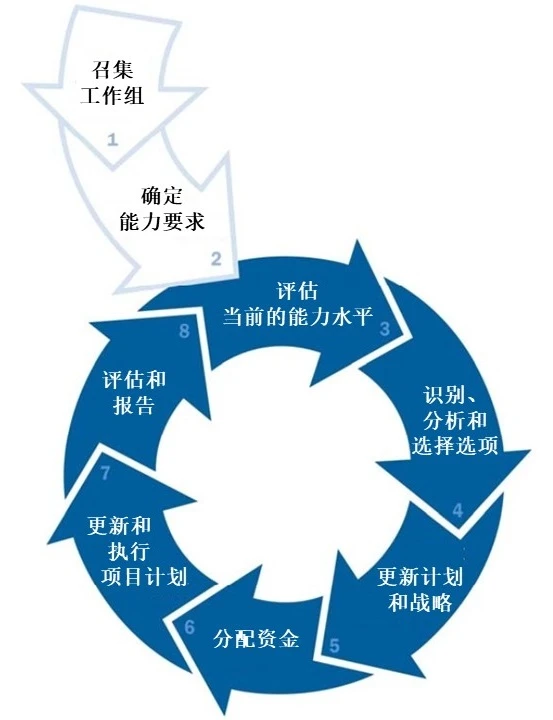
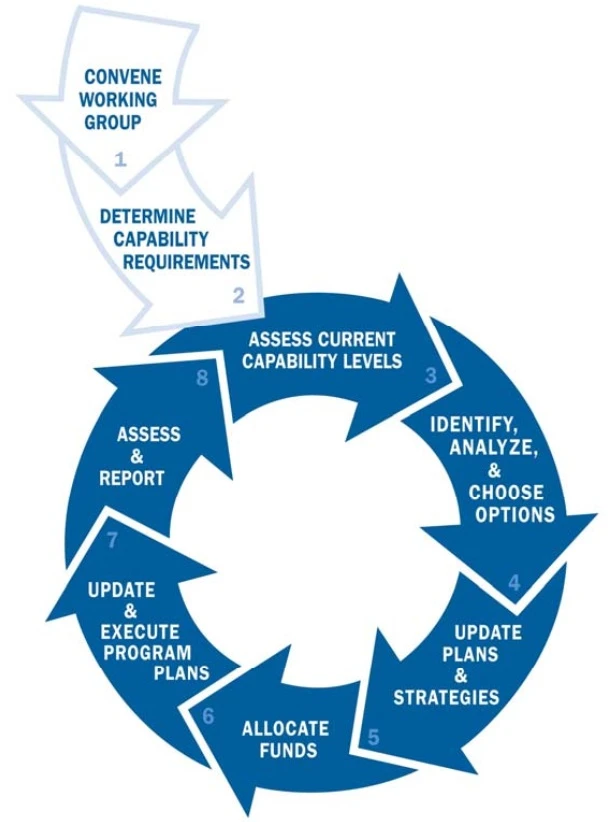
审查相关战略和政策,以确定需要培训和演练的TCL优先能力
为预期的培训和演练活动编制多年期的培训和演练计划和时间表
根据多年期计划,开展计划的培训活动,以提高TCL的优先能力
开展演练,应用和评估通过培训开发的TCL优先能力
使用不断升级演练复杂性的”积木式循环”(例如,桌面演练,然后操练,接着是全面演练)来逐步建立TCL的优先能力水平
使用与每个TCL能力相关的国土安全演练和评价项目演练评价指南来评价演练中测试的能力
每年更新多年期计划,以反映新的优先能力和从演练中吸取的经验教训
有关培训和演练的基于能力的准备规划的更多信息,请参阅国土安全演练和评价项目第一卷:概述和演练项目管理(http://hseep.dhs.gov).
Capabilities-Based Preparedness for Training and Exercises
Review relevant strategy and policy to identify priority TCL capabilities to be trained for and exercised against
Develop a Multi-Year Training and Exercise Plan and Schedule for intended training and exercise activities
Per the Multi-Year Schedule, carry out planned training activities oriented toward augmenting priority TCL capabilities
Conduct exercises that apply and evaluate the priority TCL capabilities developed through training
Use a “building-block cycle” of escalating exercise complexity (e.g., tabletop exercise, followed by a drill, followed by a full-scale exercise) to incrementally build priority TCL capability levels
Evaluate capabilities tested in exercises using Homeland Security Exercise and Evaluation Program Exercise Evaluation Guides linked to each TCL capability
Update Multi-Year Plan annually to reflect new priority capabilities and lessons learned from exercises
For more on Capabilities-Based Preparedness Planning for training and exercises, see Homeland Security Exercise and Evaluation Program Volume I: Overview and Exercise Program Management (http://hseep.dhs.gov).
附录C——术语和定义 APPENDIX C— Terms and Definitions
全危险准备 指为美国境内的恐怖袭击、重大灾难和其他紧急情况做准备。(资料来源:HSPD-8,2003年12月17日)
All-Hazards Preparedness. Refers to preparedness for terrorist attacks, major disasters, and other emergencies within the United States. (Source: HSPD-8, December 17, 2003)
能力 能力提供了在特定条件下由执行一项或多项关键任务而完成使命和功能达到目标绩效水平的手段。能力可以借由合理规划、组织、装备、培训和演练的人员实现预期结果的任何组合而得到。
Capability. A capability provides the means to accomplish a mission or function resulting from the performance of one or more critical tasks, under specified conditions, to target levels of performance. A capability may be delivered with any combination of properly planned, organized, equipped, trained, and exercised personnel that achieves the desired outcome.
关键基础设施 关键基础设施被定义为对美国至关重要的系统和资产(无论是物理的还是虚拟的),以至于这些系统和资产的失效或破坏将对国家安全、国家经济安全或国家公共卫生或安全的任何组合产生削弱性影响。(资料来源:2001年《美国爱国者法》和2002年《国土安全法》,《美国法典》第6卷第101节等)
Critical Infrastructure. Critical infrastructure is defined as systems and assets, whether physical or virtual, so vital to the United States that the incapacity or destruction of such systems and assets would have a debilitating impact on any combination of national security, national economic security, or national public health or safety. (Source: USA PATRIOT Act of 2001 and Homeland Security Act of 2002, 6 U.S.C. § 101 et seq.)
关键任务 关键任务是指那些对于在预防重大事件发生、最大限度地减少生命损失和严重伤害,或减轻重大财产损失的国土安全使命中取得成功至关重要的任务。
Critical Tasks. Critical tasks are those tasks essential to achieving success in a homeland security mission for a major event to prevent an occurrence, to minimize loss of life and serious injuries, or to mitigate significant property damage.
紧急情况 根据《罗伯特·T·斯塔福德救灾和紧急援助法》(《美国法典》第42卷第5121节等)的定义,紧急情况是指总统确定需要联邦援助以补充州和地方的努力和能力,以拯救生命、保护财产和公共健康与安全,或减轻或避免美国任何地区的灾难威胁的任何场合或情况。(资料来源:NRP,2004年12月)
Emergency. As defined by the Robert T. Stafford Disaster Relief and Emergency Assistance Act (42 U.S.C. § 5121 et seq.), an emergency means any occasion or instance for which, in the determination of the President, Federal assistance is needed to supplement State and local efforts and capabilities to save lives and to protect property and public health and safety or to lessen or avert the threat of a catastrophe in any part of the United States. (Source: NRP, December 2004)
联邦部门和机构 《美国法典》第5卷第101节列举的执行部门;《美国法典》第5卷第104(1)节定义的独立机构;《美国法典》第5卷第103(1)节定义的政府公司;以及美国邮政局。(资料来源:HSPD-8,2003年12月17日)
Federal Departments and Agencies. Those executive departments enumerated in 5 U.S.C. 101; independent establishments as defined by 5 U.S.C. § 104(1); government corporations as defined by 5 U.S.C. § 103(1); and the United States Postal Service. (Source: HSPD-8, December 17, 2003)
第一响应者 在事件发生初期负责保护和维护生命、财产、证据和环境的当地和非政府的警察、消防和其他应急人员。这包括2002年《国土安全法》第2节中定义的应急响应提供者,以及在预防、响应和恢复行动期间提供即时支持服务的应急管理、公共卫生、临床护理、公共工程和其他熟练支持人员(如设备操作员)。第一响应者可能包括来自联邦、州、地方、部落、领地或非政府组织的人员。(资料来源:NRP,2004年12月)
First Responder. Local and nongovernmental police, fire, and other emergency personnel who, in the early stages of an incident, are responsible for the protection and preservation of life, property, evidence, and the environment. This includes emergency response providers as defined in section 2 of the Homeland Security Act of 2002, as well as emergency management, public health, clinical care, public works, and other skilled support personnel (such as equipment operators) who provide immediate support services during prevention, response, and recovery operations. First responders may include personnel from Federal, State, local, tribal, territorial, or nongovernmental organizations. (Source: NRP, December 2004)
管辖区 权力的范围或领域。公共机构对与其法律责任和权力有关的事件有管辖范围。事件的管辖权可以是政治的或地理的(如市、县、领地、部落、州或联邦的边界线)或职能(如执法、公共卫生)。(资料来源:NIMS,2004年3月)
Jurisdiction. A range or sphere of authority. Public agencies have jurisdiction at an incident related to their legal responsibilities and authority. Jurisdictional authority at an incident can be political or geographic (e.g., city, county, territorial, tribal, State, or Federal boundary lines) or functional (e.g., law enforcement, public health). (Source: NIMS, March 2004)
关键资源 关键资源被定义为”对经济和政府的最低限度运作至关重要的公共或私人控制的资源”。(来源:2002年《国土安全法》)
Key Resources. Key resources are defined as “publicly or privately controlled resources essential to the minimal operations of the economy and government.” (Source: Homeland Security Act of 2002)
地方政府 地方被定义为”(A)县、自治市、市、镇、乡、地方公共机构、学区、特区、州内地区、政府委员会(不管政府委员会是否根据州法律成立为非营利公司)、地区或州际政府实体,或地方政府的机构或部门;(B)印第安部落或授权的部落组织,或阿拉斯加的原住民村庄或阿拉斯加地区原住民公司;以及(C)农村社区、非法人城镇或村庄或其他公共实体”。(来源:2002年《国土安全法》)
Local Government. Local is defined as “(A) a county, municipality, city, town, township, local public authority, school district, special district, intrastate district, council of governments (regardless of whether the council of governments is incorporated as a nonprofit corporation under State law), regional or interstate government entity, or agency or instrumentality of a local government; (B) an Indian tribe or authorized tribal organization, or in Alaska a Native village or Alaska Regional Native Corporation; and (C) a rural community, unincorporated town or village, or other public entity.” (Source: Homeland Security Act of 2002)
重大灾难 根据《罗伯特·T·斯塔福德救灾和紧急援助法》(《美国法典》第42卷第5122节)的定义,重大灾害是指发生在美国任何地区的任何自然灾害(包括任何飓风、龙卷风、风暴、高水位、风力驱动的水、潮汐、海啸、地震、火山喷发、山体滑坡、泥石流、暴风雪或干旱)或任何火灾、洪水或爆炸,无论原因如何。总统认为造成损害的严重程度和规模足以根据本法提供重大灾难援助,以补充州、地方政府和救灾组织的努力和现有资源,减轻由此造成的损害、损失、困难或痛苦。(资料来源:NIMS,2004年3月)
Major Disaster. As defined under the Robert T. Stafford Disaster Relief and Emergency Assistance Act (42 U.S.C. 5122), a major disaster is any natural catastrophe (including any hurricane, tornado, storm, high water, wind-driven water, tidal wave, tsunami, earthquake, volcanic eruption, landslide, mudslide, snowstorm, or drought) or, regardless of cause, any fire, flood, or explosion, in any part of the United States, which in the determination of the President causes damage of sufficient severity and magnitude to warrant major disaster assistance under this act to supplement the efforts and available resources of States, local governments, and disaster relief organizations to alleviate the damage, loss, hardship, or suffering caused thereby. (Source: NIMS, March 2004)
重大事件 指美国境内的恐怖袭击、重大灾害和其他紧急情况。(资料来源:HSPD-8,2003年12月17日)
Major Event. Refers to terrorist attacks, major disasters, and other emergencies within the United States. (Source: HSPD-8, December 17, 2003)
大规模预防 整个社区在一段规定的时间内接受预防性药物和疫苗的过程,以应对可能的生物制剂接触。(资料来源:基于社区的大规模预防——公共卫生准备规划指南,卫生保健研究和质量局,2004年8月)
Mass Prophylaxis. The process by which an entire community is to receive prophylactic drugs and vaccines over a defined period of time in response to possible exposure to a biological agent. (Source: Community-Based Mass Prophylaxis – A Planning Guide for Public Health Preparedness, Agency for Healthcare Research and Quality, August 2004)
度量和指标 定量或定性水平的绩效度量,用以评估任务或能力成果的实现情况。它们描述了一个动作应该执行多少、多好和/或多快,并且通常可以在演练或真实事件中观察到的方式表达。度量和指标不是标准。它们可用于指导计划、培训和演练活动。但是,反映了国家认可的绩效标准、基准和指导方针(如适用)。(资料来源:目标能力清单,2007年3月)
Measures and Metrics. Performance measures of quantitative or qualitative levels against which achievement of a task or capability outcome can be assessed. They describe how much, how well, and/or how quickly an action should be performed and are typically expressed in way that can be observed during an exercise or real event. The measures and metrics are not standards. They serve as guides for planning, training, and exercise activities. However, nationally accepted standards of performance, benchmarks, and guidelines are reflected, if applicable. (Source: Target Capabilities List, March 2007)
缓解 旨在减少或消除人员或财产风险,或减少事故的实际或潜在影响或后果的活动。缓解措施可以在事件发生之前、期间或之后实施。缓解措施往往借鉴以往事件的经验教训。缓解包括持续采取行动,减少危险的暴露、可能性或潜在损失。措施可能包括分区和建筑规范、洪泛区收购以及分析与危害相关的数据,以确定在何处建造或设置临时设施是安全的。缓解可以包括教育政府、企业和公众如何采取措施减少损失和伤害的工作。(资料来源:NIMS,2004年3月)
Mitigation. The activities designed to reduce or eliminate risks to persons or property or to lessen the actual or potential effects or consequences of an incident. Mitigation measures may be implemented prior to, during, or after an incident. Mitigation measures are often informed by lessons learned from prior incidents. Mitigation involves ongoing actions that reduce exposure to, probability of, or potential loss from hazards. Measures may include zoning and building codes, floodplain buyouts, and analysis of hazard-related data to determine where it is safe to build or locate temporary facilities. Mitigation can include efforts to educate governments, businesses, and the public on measures they can take to reduce loss and injury. (Source: NIMS, March 2004)
国家级 具有全国性特征的,包括联邦、州、地方、部落和领地方面的治理和政策。(资料来源:NIMS,2004年3月)
National. Of a nationwide character, including the Federal, State, local, tribal, and territorial aspects of governance and policy. (Source: NIMS, March 2004)
准备 为建立、维持和提高预防、保护、响应和从国内事件中恢复的行动能力所需的一系列深思熟虑的、关键任务和活动。准备是一个持续的过程。准备涉及各级政府的工作,以及政府、私营部门和非政府组织之间的协调,以识别威胁、确定脆弱性,并确定所需的资源。在NIMS中,准备的重点是制定规划、培训和演练、人员资格和认证、设备认证和出版物管理的指导方针、协议和标准。(资料来源:NIMS,2004年3月)
Preparedness. The range of deliberate, critical tasks and activities necessary to build, sustain, and improve the operational capability to prevent, protect against, respond to, and recover from domestic incidents. Preparedness is a continuous process. Preparedness involves efforts at all levels of government and coordination among government, private-sector, and nongovernmental organizations to identify threats, determine vulnerabilities, and identify required resources. Within the NIMS, preparedness is operationally focused on establishing guidelines, protocols, and standards for planning, training and exercises, personnel qualification and certification, equipment certification, and publication management. (Source: NIMS, March 2004)
预防 避免事件或进行干预以阻止事件发生的行动。预防包括为保护生命和财产而采取的行动。它涉及将情报和其他信息应用于一系列活动,其中可能包括威慑行动等反制措施;加强检查;改进监视和安保行动;进行调查,以确定威胁的全部性质和来源;公共卫生和农业监测和检测程序;免疫接种、隔离或检疫;以及酌情采取具体的执法行动,旨在威慑、先发制人、拦截或破坏非法活动,逮捕潜在肇事者并将其绳之以法。根据HSPD-8,国家准备指导方针没有涉及联邦执法、国防和情报机构在威慑、破坏或挫败恐怖主义方面更普遍和更广泛的预防工作。(资料来源:NIMS,2004年3月;HSPD-8,2003年12月17日)
Prevention. Actions to avoid an incident or to intervene to stop an incident from occurring. Prevention involves actions taken to protect lives and property. It involves applying intelligence and other information to a range of activities that may include such countermeasures as deterrence operations; heightened inspections; improved surveillance and security operations; investigations to determine the full nature and source of the threat; public health and agricultural surveillance and testing processes; immunizations, isolation, or quarantine; and, as appropriate, specific law enforcement operations aimed at deterring, preempting, interdicting, or disrupting illegal activity and apprehending potential perpetrators and bringing them to justice. Under HSPD-8, the National Preparedness Guidelines do not address more general and broader prevention efforts to deter, disrupt, or thwart terrorism by Federal law enforcement, defense, and intelligence agencies. (Source: NIMS, March 2004; HSPD-8, December 17, 2003)
保护 减少关键基础设施或关键资源脆弱性的行动,以阻止、减轻或消除恐怖袭击、重大灾害和其他紧急情况。这需要联邦、州和地方政府、私营部门以及全国关心此事的公民采取协调一致的行动。保护还包括政府的连续性和行动规划;提高对其关键设施、系统和功能的威胁和脆弱性的认识和理解;确定和促进针对特定部门的有效保护实践和方法;以及扩大行业内私营实体之间以及政府与私营实体之间安全相关信息的自愿共享。(资料来源:HSPD-7,2003年12月17日)
Protection. Actions to reduce the vulnerability of critical infrastructure or key resources in order to deter, mitigate, or neutralize terrorist attacks, major disasters, and other emergencies. It requires coordinated action on the part of Federal, State, and local governments, the private sector, and concerned citizens across the country. Protection also includes continuity of government and operations planning; awareness elevation and understanding of threats and vulnerabilities to their critical facilities, systems, and functions; identification and promotion of effective sector-specific protection practices and methodologies; and expansion of voluntary security-related information sharing among private entities within the sector as well as between government and private entities. (Source: HSPD-7, December 17, 2003)
恢复 服务和站点恢复计划的制定、协调和执行;政府运作和服务的重组;提供住房和促进恢复的个人、私营部门、非政府和公共援助项目;受影响人员的长期护理和治疗;社会、政治、环境和经济恢复的其它措施;对事件进行评估,以确定经验教训;事件后报告;以及制定措施以减轻未来事件的影响。(资料来源:NIMS,2004年3月)
Recovery. The development, coordination, and execution of service and site restoration plans; the reconstitution of government operations and services; individual, private-sector, nongovernmental, and public assistance programs to provide housing and promote restoration; long-term care and treatment of affected persons; additional measures for social, political, environmental, and economic restoration; evaluation of the incident to identify lessons learned; post-incident reporting; and development of initiatives to mitigate the effects of future incidents. (Source: NIMS, March 2004)
区域 一般指由邻近的联邦、州、地方、领地和部落实体组成的地理区域。
Region. Generally refers to a geographic area consisting of contiguous Federal, State, local, territorial, and tribal entities.
响应 处理事件的短期直接影响的活动。响应包括立即采取行动拯救生命、保护财产和满足人类基本需求。响应还包括执行应急行动计划和旨在限制生命损失、人身伤害、财产损失和其他不利后果的缓解活动。根据情况,响应活动包括运用情报和其他信息来减轻事件的影响或后果;加强安保行动;继续调查威胁的性质和来源;正在进行的公共卫生和农业监测和检测过程;免疫接种、隔离或检疫;以及旨在先发制人、阻止或破坏非法活动、逮捕真正的肇事者并将其绳之以法的具体执法行动。(资料来源:NIMS,2004年3月)
Response. Activities that address the short-term, direct effects of an incident. Response includes immediate actions to save lives, protect property, and meet basic human needs. Response also includes the execution of emergency operations plans and of mitigation activities designed to limit the loss of life, personal injury, property damage, and other unfavorable outcomes. As indicated by the situation, response activities include applying intelligence and other information to lessen the effects or consequences of an incident; increased security operations; continuing investigations into the nature and source of the threat; ongoing public health and agricultural surveillance and testing processes; immunizations, isolation, or quarantine; and specific law enforcement operations aimed at preempting, interdicting, or disrupting illegal activity, apprehending actual perpetrators, and bringing them to justice. (Source: NIMS, March 2004)
风险 风险是三个变量的函数:威胁、脆弱性和后果。(资料来源:“关于2006财政年度风险方法和城市地区安全倡议的讨论”,2005年11月,www.ojp.usdoj.gov/odp/docs/FY_2006_UASI_Program_Explanation_Paper_011805.doc)
Risk. Risk is a function of three variables: threat, vulnerability, and consequence. (Source: “Discussion of the FY 2006 Risk Methodology and the Urban Areas Security Initiative,” November 2005, www.ojp.usdoj.gov/odp/docs/FY_2006_UASI_Program_Explanation_Paper_011805.doc)
州政府 美国任何州、哥伦比亚特区、波多黎各联邦、维尔京群岛、关岛、美属萨摩亚、北马里亚纳群岛联邦和美国任何属地的管理机构。(资料来源:2002年《国土安全法》)
State Government. The governing body of any State of the United States, the District of Columbia, the Commonwealth of Puerto Rico, the Virgin Islands, Guam, American Samoa, the Commonwealth of the Northern Mariana Islands, and any possession of the United States. (Source: Homeland Security Act of 2002)
志愿者 由有权接受志愿服务的机构接受提供服务的个人,如果该人员提供服务时没有承诺、期望或获得报酬。(资料来源:NIMS,2004年3月)
Volunteer. Any individual accepted to perform services by an agency that has the authority to accept volunteer services, if that individual performs services without promise, expectation, or receipt of compensation for services performed. (Source: NIMS, March 2004)
附录D——首字母缩略词和缩写词 APPENDIX D— ACRONYMS AND ABBREVIATIONS
| 缩写 Acronym | 全称 Full Name |
|---|---|
| CBRNE | 化学、生物、辐射性、核和爆炸物 Chemical, Biological, Radiological, Nuclear, and Explosive |
| CDC | 美国疾病控制与预防中心 Centers for Disease Control and Prevention |
| CI/KR | 关键基础设施/关键资源 Critical Infrastructure/Key Resources |
| CRI | 城市就绪倡议 Cities Readiness Initiative |
| DHS | 国土安全部 Department of Homeland Security |
| DOJ | 司法部 Department of Justice |
| EEG | 演练评估指南 Exercise Evaluation Guide |
| EMAC | 应急管理援助契约 Emergency Management Assistance Compact |
| EMS | 紧急医疗服务 Emergency Medical Services |
| FBI | 联邦调查局 Federal Bureau of Investigation |
| HHS | 卫生与公众服务部 Department of Health and Human Services |
| HSPD | 国土安全总统令 Homeland Security Presidential Directive |
| ICS | 事件指挥系统 Incident Command System |
| IWN | 综合无线网络 Integrated Wireless Network |
| ISE | 信息共享环境 Information Sharing Environment |
| JTTF | 联合反恐特遣队 Joint Terrorism Task Force |
| NEMA | 国家应急管理协会 National Emergency Management Association |
| NIMS | 国家事件管理系统 National Incident Management System |
| NIPP | 国家基础设施保护计划 National Infrastructure Protection Plan |
| NRP | 国家响应计划 National Response Plan |
| ODP | 国内准备办公室 Office for Domestic Preparedness |
| SSP | 特定部门计划 Sector-Specific Plan |
| TCL | 目标能力清单 Target Capabilities List |
| UASI | 城市地区安全倡议 Urban Areas Security Initiative |
| UTL | 通用任务清单 Universal Task List |
| WMD | 大规模杀伤性武器 Weapons of Mass Destruction |